Why your resume reads like a job description (and how to fix it)
ESTIMATED TIME
10
mins

Written by
Shikha Prasad
Published on
You wrote down your duties, and a duties list could belong to anyone. Here's how to make it sound like you.
I've read a lot of resumes, and most of them share the same quiet problem. I'll get through three bullets and still have no idea whether the person was any good. The bullets are accurate. They're also interchangeable. “Responsible for facilitating Scrum ceremonies.” “Managed the sprint backlog.” “Coordinated with stakeholders.” I could lift those off one resume, drop them onto fifty others, and nobody would notice.
That's the trap. Your resume reads like a job description because you wrote down the job, not what you did with it.
Duties describe the chair, not the person in it
A job description is a list of responsibilities the role carries. By definition, it's true for anyone who has ever held the title. So when your resume is a list of duties, you've written something that proves you had the job and proves nothing about whether you were good at it.
And “were you good at it” is the only thing the reader is actually trying to work out. They already know what a Scrum Master does. What they can't tell from “responsible for facilitating ceremonies” is whether your ceremonies changed anything, or just happened on schedule while the team quietly struggled underneath them.
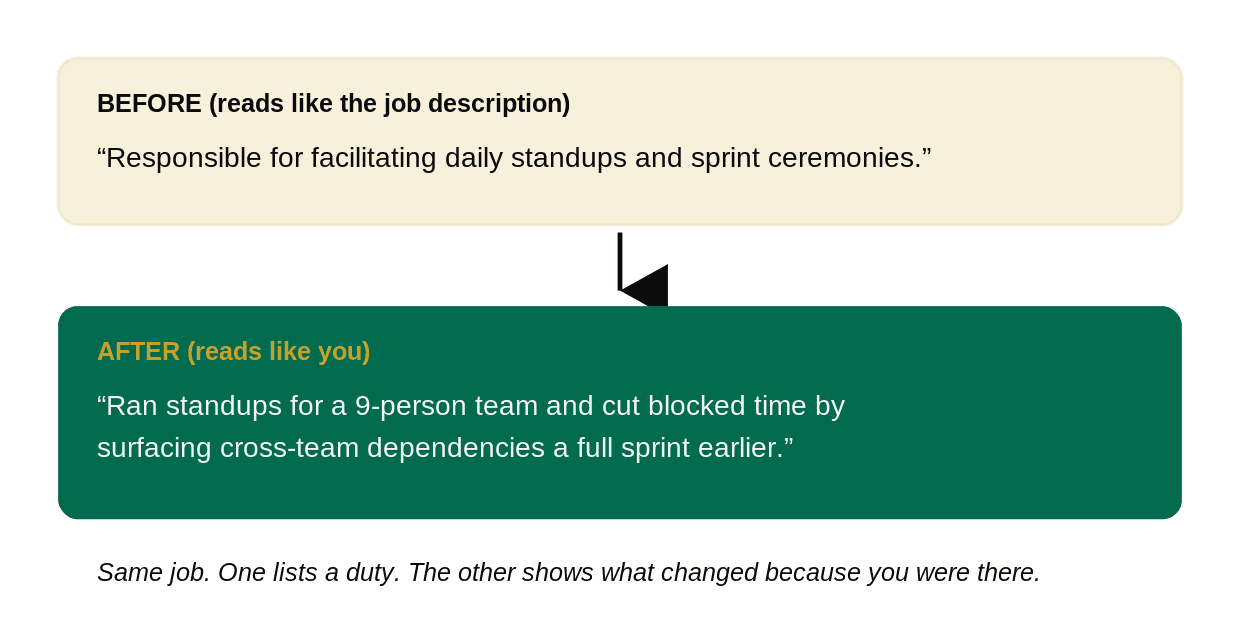
Look at the difference. “Responsible for facilitating daily standups” tells me your calendar. “Ran standups for a nine-person team and cut blocked time by surfacing cross-team dependencies a sprint earlier” tells me you. Same event. One is a duty. The other is a result, and results are the part a reader actually remembers.
Why this matters more than it should
You might be hoping a good reader will see past the dull phrasing to the real you underneath. They won't, and not because they're lazy. They simply don't have the time.
An eye-tracking study by Ladders found that recruiters spend an average of 7.4 seconds on the first pass of a resume {Ladders, 2018}. Seven seconds. They're skimming for titles, companies, and anything that jumps out. A wall of identical duty bullets gives the eye nothing to catch on, so it slides to the next candidate.
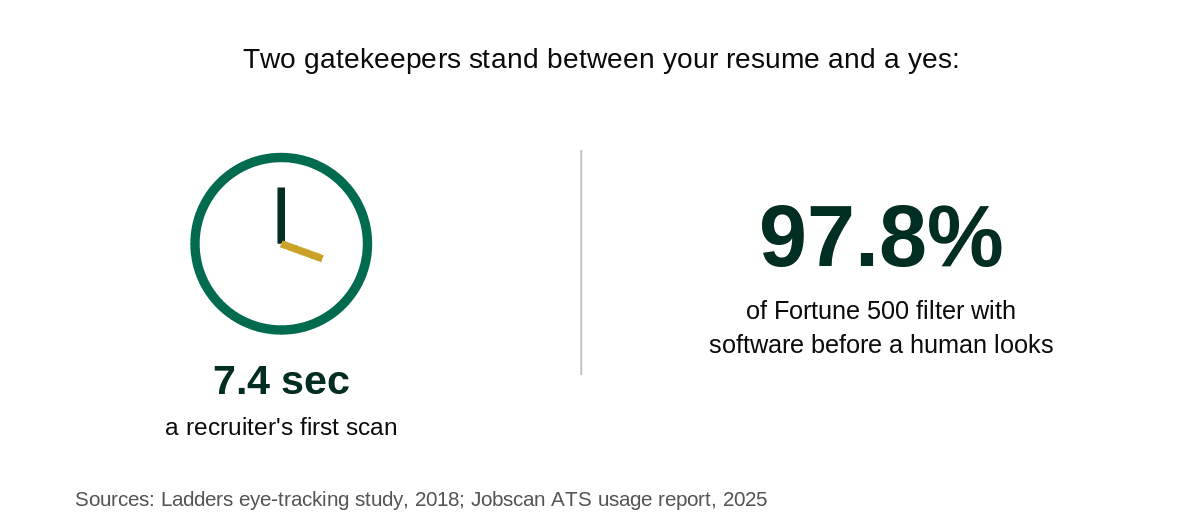
And before a human gets those seven seconds, software usually goes first. Around 98 percent of Fortune 500 companies use an applicant tracking system to screen applications {Jobscan, 2025}. Those systems reward specific, relevant language. “Responsible for various tasks” is exactly the kind of vague filler that helps neither the machine nor the human decide you're worth a longer look.
Which leads to one honest move, since the software reads first. Tailor the language to the specific posting. If the job asks for “stakeholder management” and you did exactly that under a different name, use their words for the real thing you did. That isn't gaming the system. It's translation, the same skill you'd use in the interview. What you never do is paste in a keyword for work you didn't actually do, because the interview is where that gets tested, and “tell me more about that” is a very short bridge to fall off.
The fix: write the result, not the role
Here's the shift, and it's simpler than it sounds. For every bullet, stop right after you've written the duty and ask one question. So what happened because I was there? Then write that instead.
There's a shape that works.
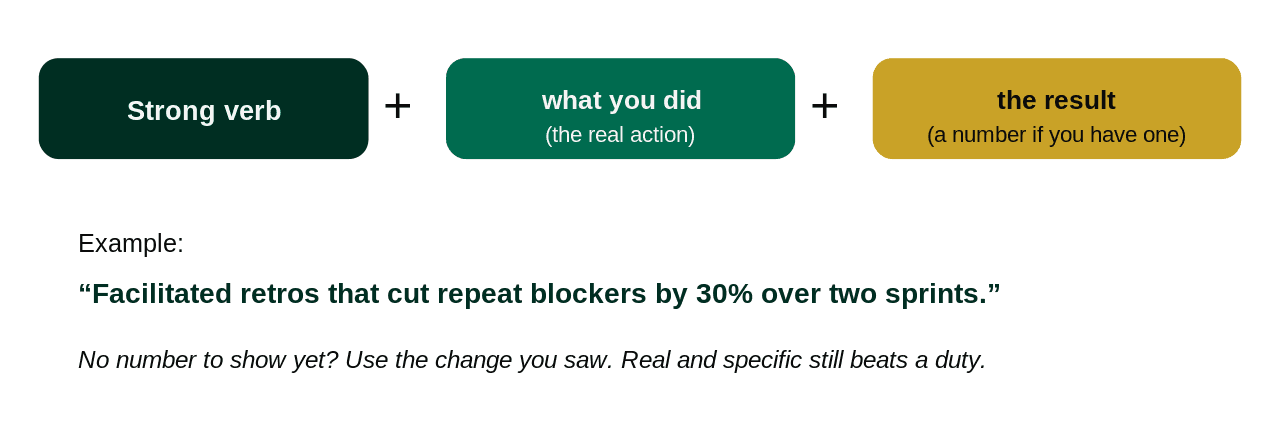
A strong verb, the real thing you did, and the result, with a number if you have one. “Facilitated retros that cut repeat blockers by 30 percent over two sprints.” “Rebuilt the intake process and dropped average request turnaround from nine days to three.” Notice these aren't bragging. They're just specific, and specific is what makes a line sound like a person who was actually in the room getting an outcome, rather than a person who occupied a seat near where outcomes happened.
And this works no matter where you're coming from, which is exactly what you need if you're switching in. A support lead's “handled customer escalations” becomes “owned escalation triage for a 12-person queue and cut repeat tickets by naming the three root causes nobody had pinned down.” An office coordinator's “scheduled team meetings” becomes “restructured the weekly planning meeting so decisions got made in the room instead of in five follow-up threads.” Same real work, in both cases. You're not inflating it. You're finally describing what it actually accomplished.
Do this honestly, especially if you're newer
Now the part that matters most, because this advice gets twisted into the wrong thing. Writing impact bullets is not the same as inventing impact. If you didn't cut blocked time by 30 percent, don't write that you did. The moment a number is made up, it becomes a liability, because a decent interviewer will ask you to walk through how you got it, and the story comes apart in real time.
If you're early and don't have big metrics yet, you have two honest options, and both beat a duty. Use the real change you saw, even without a clean number: “reworked the standup format so blockers got raised the day they appeared, not at sprint end.” Specific, and true. Or go get a real result to point to. Run a small project, volunteer to facilitate a real team, fix one broken process where you already work, and now you have something genuine to write down. You never fabricate the experience. You go and get a small version of it, then describe it like the professional you're becoming.
Run the test on every line
So before you send the next version out, run one test on every bullet. Read it and ask whether it could appear, word for word, on the resume of anyone who held your job. If it could, it's a duty, and it's wasting one of your seven seconds. Rewrite it as the thing that changed because you, specifically, were the one doing it.
Your resume isn't a record of what you were responsible for. It's the evidence that you were good at it. Make every line carry a little of that evidence, honestly, and it stops reading like a job description and starts reading like you.
Sources
Ladders. “Eye-Tracking Study” (recruiters average 7.4 seconds on the first resume scan). 2018. theladders.com (study release)
Jobscan. “Fortune 500 ATS Usage Report.” 2025. jobscan.co
Subscribe to the Newsletter
Join our growing community and get alerted first on our every article.
*By subscribing, you agree to send your information to our Company who agrees to use it according to their Terms and conditions and Privacy Policy
About the author
I believe the strongest tool and flex each of us has is our belief. When we truly believe in something, we align our mindset, energy, and actions with the right effort and guidance. That is when achieving almost anything becomes possible. This is how I help mentees at OAKKTREEUNII move into Software and Project Management careers for better pay, better confidence, and better work-life balance.
Comments