PSM, CSM, or PMP: which one actually moves the hiring decision
ESTIMATED TIME
12
mins

Written by
Rajveer Prasad
Published on
You are asking which key opens the door. The hiring manager already opened it. They are asking a different question, and your three letters do not answer it.
Let me save you a forum war.
Every week someone asks the same question in a Slack group or a Reddit thread. PSM, CSM, or PMP. Which one gets me hired. Which one do recruiters respect. Which three letters are worth the money. And every week the same three camps show up to defend their badge like it is a football team.
Here is the uncomfortable part. The question is wrong, and the wrongness is costing people months.
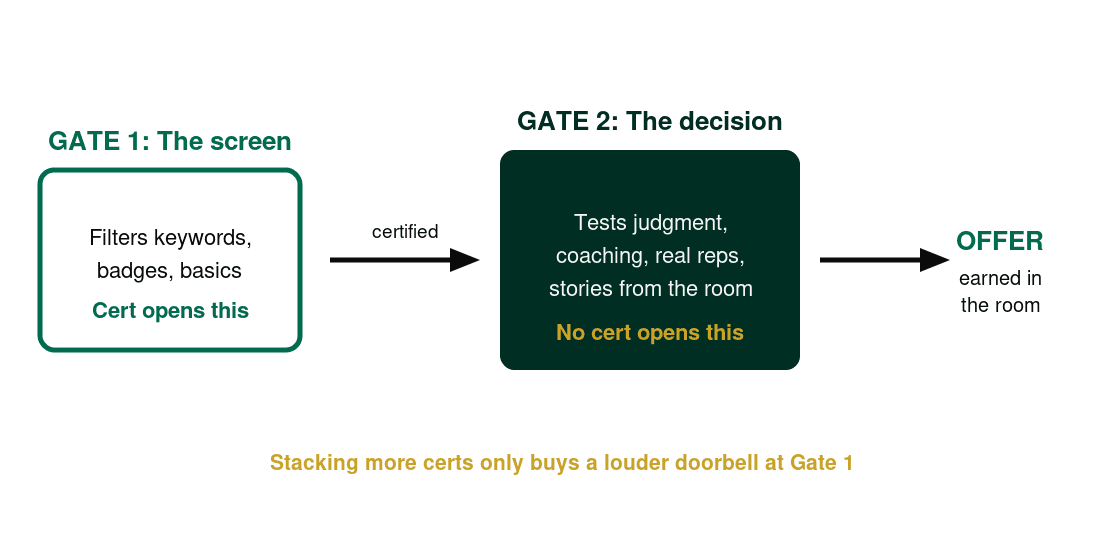
The honest answer is that none of the three moves the hiring decision the way you think it does. Not PSM. Not CSM. Not PMP. They move the screen, which is the part before a human reads anything closely. The decision gets made later, in a room, by a person who has stopped caring which exam you passed and started asking whether you have ever actually done the work. Those are two different gates, and the whole anxiety in that forum thread comes from treating them as one.
So this post is not going to crown a winner. It is going to do something more useful. It is going to tell you which gate each certification opens, which gate it does not, and what actually moves the one that matters.
What you are really buying with each one
Strip the marketing off and the three credentials are not even competing for the same job. They answer different questions, and once you see that, the "which is best" fight mostly dissolves.
PSM, the Professional Scrum Master from Scrum.org, is a knowledge test. Two hundred dollars, eighty questions, sixty minutes, and you need eighty-five percent to pass. {Scrum.org, PSM I} You do not have to attend a class. You do not have to prove a single day of experience. You sit the exam and either you understand the Scrum Guide cold or you do not. It is also a lifetime certification with no renewal fee. {Scrum.org, PSM I} In plain terms, PSM says "this person knows the framework." That is the whole claim. It is a real claim, and it is a narrow one.
CSM, the Certified ScrumMaster from Scrum Alliance, is a course plus an easier test. You attend a sixteen-hour class taught by a certified trainer, then pass a fifty-question exam where thirty-seven correct gets you through. {Scrum Alliance, CSM} Course prices run anywhere from $250 to $2,495 because the trainers set their own rates. {Scrum Alliance, CSM} And it expires. You renew every two years by logging continuing education units. {Scrum Alliance, CSM} CSM says "this person sat in a real room with a real trainer and learned the basics." Slightly different claim. The signal is exposure, not just knowledge.
PMP, the Project Management Professional from PMI, is the only one of the three that gates on experience before you even sit the exam. To qualify you need a bachelor's degree, thirty-six months of leading projects, and thirty-five hours of project management education. {PMI, PMP} The exam is a hundred and eighty questions over two hundred and thirty minutes. {PMI, PMP} PMP says "this person has already run projects and can prove it on paper." That is a fundamentally bigger claim than the other two, because PMI checked your experience to let you in the door.
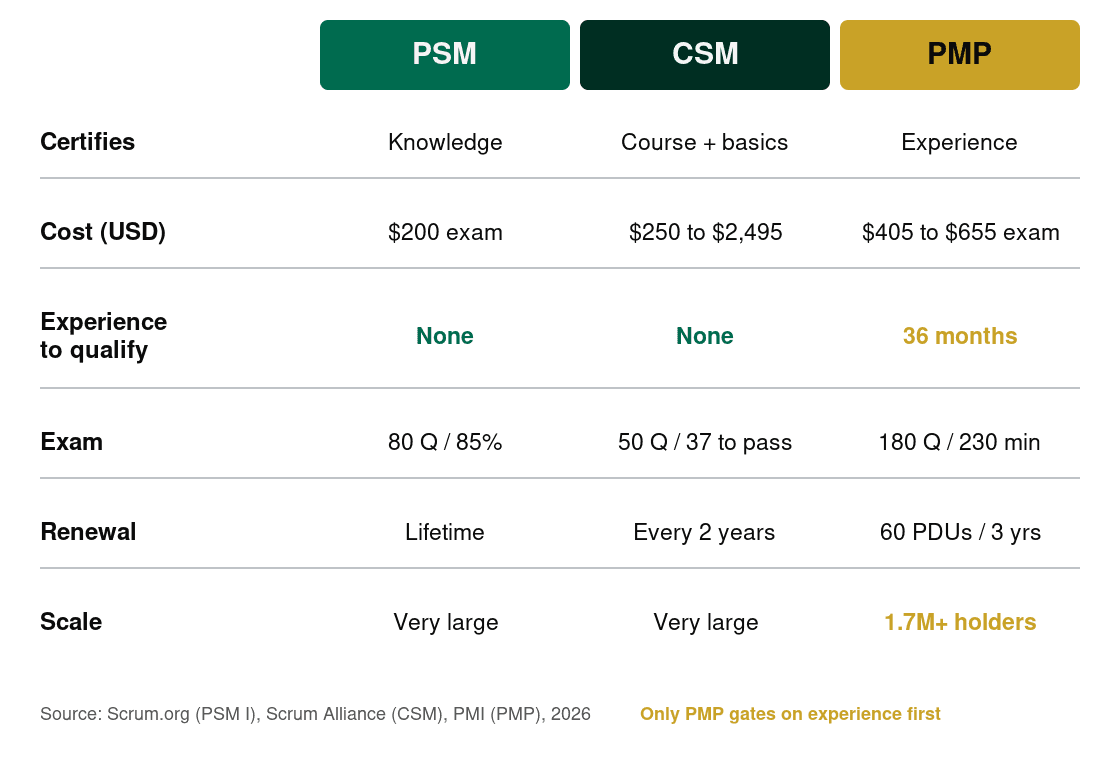
Read that again, because it is the part nobody says out loud in the forum thread. PSM and CSM certify that you know the thing. PMP certifies that you have, at minimum, done the thing for three years. They are not three flavors of the same product. One of them is a knowledge badge and one of them is, partly, an experience badge. That difference matters more than the brand on any of them.
The baseline trap
Now the spicy part.
There is a number that should reframe this entire debate. There are more than 1.7 million active PMP holders worldwide. {PMI, PMP} The hardest, most experience-gated credential in this conversation, the one people treat as the trump card, is held by over one and a half million people. CSM and PSM numbers are larger still and far easier to get.
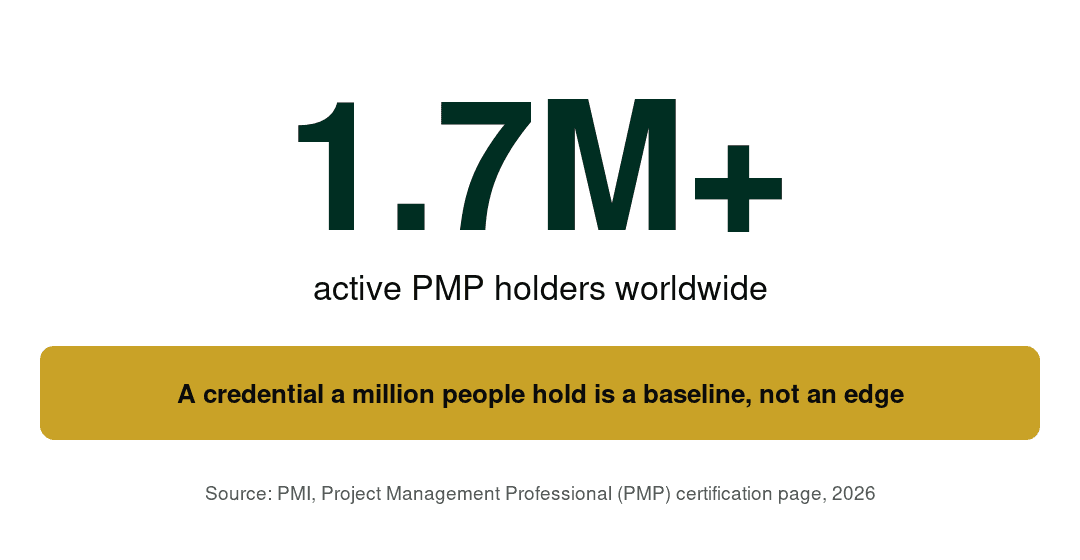
Think about what that does to a hiring manager's inbox. When a credential is rare, it is a signal. When more than a million people have it, it is a baseline. It stops telling the manager who is special and starts telling them who cleared the absolute minimum. A recruiter in a busy market has seen the badge so many times it has gone invisible. It is wallpaper.
This is the trap. The certification industry sells these as differentiators, and ten years ago, for some of them, that was closer to true. Today the market has caught up. When everyone in the stack has the letters, the letters cannot be what separates you, by definition. A thing that everyone has cannot make you stand out. It can only keep you from being thrown out.
So here is the line I want you to sit with. Your certification is not what gets you the job. It is what stops you from being filtered before the job conversation starts. Those sound similar. They are opposites. One is an accelerator and one is a hall pass, and confusing the two is exactly why people stack three credentials and still hear nothing back.
What the person who decides is actually weighing
Let me bring in the only opinion in this whole debate that pays your salary. The hiring manager's.
A technical recruiter who has screened and interviewed thousands of Scrum Master candidates put it about as plainly as it gets. She said she is "more interested in learning about a Scrum Master candidate's coaching and interpersonal skills than their certifications," and that she would "rather hire an experienced Scrum Master with excellent people skills over one that has no experience but who boasts an official certification." {Parabol, recruiter Q&A} She did not say certifications are worthless. She said something sharper. She said the certification tells her she can stop testing your Scrum trivia and start testing the things that actually predict whether you will be any good. Coaching. Facilitation. Reading a room. Holding tension without making it worse.
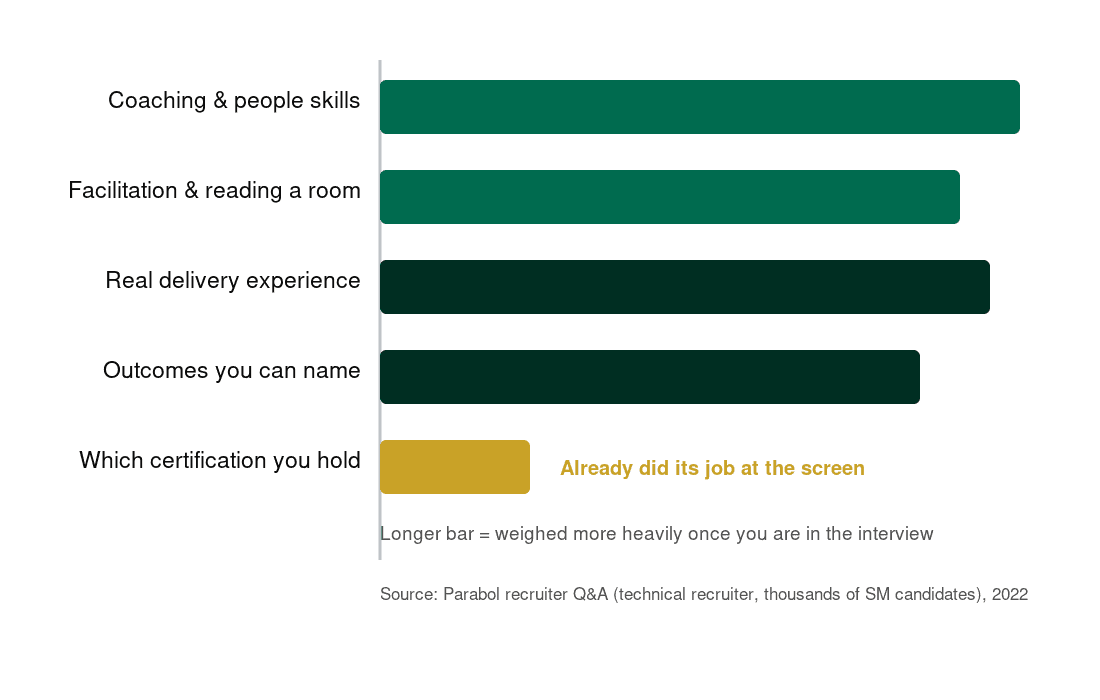
Hear what that means for the decision. The certification does a job, and the job is to get itself out of the way. It clears the knowledge question so the conversation can move to the real one. Once you are in the room, your three letters have already done everything they will ever do. From that point the decision is moved entirely by evidence that you have run real work and can talk about it like someone who was there.
This is the same pattern across the entire delivery hiring world, not just Scrum. The plan on paper gets you a meeting. What happens when the plan meets a missed dependency, a stakeholder who changed their mind, a demo environment that died an hour before the demo, that is what gets you the offer. The certification is the plan on paper. The interview is the dependency that broke.
Steelman: but the cert got me the interview
Here is the strongest version of the counterargument, and it is a good one, so I am going to give it real weight instead of swatting it.
"Rajveer, that is easy to say once you are in the room. But I could not get into any room. I added the certification, and suddenly I started getting screening calls. The cert clearly worked. You are underselling it."
That is true, and I am not going to pretend it isn't. For a career switcher with no delivery title, a certification can absolutely change your screen-through rate. It is a keyword that gets you past the filter. It signals you are serious enough to spend the money and pass the test. For someone starting cold, that first call is everything, and yes, the badge can buy it. I will not take that away from anyone.
But look closely at what that argument actually proves. It proves the certification moved the screen. That is exactly my thesis, not a hole in it. The cert got you the call. Then what happened on the call. If you have been getting screening interviews and no offers, the certification already did its entire job and the breakdown is happening at the gate it was never able to open. Stacking a second or third certification to fix a problem that lives in the interview is like buying a louder doorbell because nobody is home when you arrive. The door is not the issue. More keys do not help.
So the steelman is right about the screen and wrong about the decision, and the gap between those two is the whole point. The cert is necessary, sometimes. It is almost never sufficient. The honest read is that the first credential earns its money by getting you seen, and the second and third earn you almost nothing, because the gate they would need to open is one no certification can open for you.
So which one, then
Fine. You came for a recommendation and I will give you a real one, because "it depends" is a cop-out and the answer genuinely is not the same for everyone.
If you are aiming for the Scrum Master or Agile delivery lane and you are early, get one Scrum credential and stop. PSM if you want a respected, cheaper, lifetime badge that proves knowledge and never needs renewing. CSM if you want the live training and you learn better in a room, and you do not mind renewing it. Either is fine. Picking between them is a rounding error next to the thing you do next.
If you are aiming for traditional or hybrid project management, especially in enterprises, government, or anywhere a job posting lists it by name, PMP is the one with real weight, partly because it gated on experience to begin with. But notice you cannot even apply for it until you have three years of leading projects. Which tells you something. PMP is not a way into the field. It is a credential you earn after you are already in it. If you are trying to break in, PMP is not your move yet, and no amount of wanting it changes the eligibility rules.
And if you have already collected two or three of these and you are still not landing offers, here is the recommendation that will actually change your month. Stop buying letters. The next thing on your resume should not be a fourth credential. It should be a real, recent project you ran, with a board a stranger could read, a blocker you removed, and a result you can name. That is the thing the certification was supposed to lead to. Go get the thing.
Because the credentials answer "do you know it." The market is asking "have you done it." And the candidate who can sit across a table and say "here is a team I unblocked, here is what was stuck, here is what changed" beats the candidate with the bigger badge collection almost every time. Not because the badges are fake. Because the badges already did their job at the door, and the room is asking a question they were never built to answer.
The cert gets you into the room. What you do in the room is the actual job. Go be ready for the room.
Sources
Scrum.org, Professional Scrum Master I (PSM I) Certification.
Scrum Alliance, Certified ScrumMaster (CSM) Certification.
Project Management Institute, Project Management Professional (PMP) Certification.
Parabol, How to Prepare for a Scrum Master Interview: Expert Recruiter Q&A (Teresa Salazar, technical recruiter).

Subscribe to the Newsletter
Join our growing community and get alerted first on our every article.
*By subscribing, you agree to send your information to our Company who agrees to use it according to their Terms and conditions and Privacy Policy
About the author
With 20 years guiding high-stakes Agile transformations, I turn theory into action at Oaktreeuni—mentoring aspiring Scrum Masters to think critically, adapt fast, and lead beyond frameworks. The payoff? You step into a high-paying Scrum Master or Agile PM role already equipped to excel.
Comments