The quiet skill that survives every reorg: making delivery legible
ESTIMATED TIME
7
mins

Written by
Shikha Prasad
Published on
New leaders don't inherit your reputation. They inherit your artifacts.
The announcement landed on a Tuesday morning, the way these things usually do. A new structure. New reporting lines. An org chart with boxes that didn't quite match the people I knew were inside them. And a new VP nobody had met, inheriting four teams she'd never once watched work.
I've been through enough reorgs now to know the rhythm of the weeks that follow. First the quiet. Then the corridor math: who's safe, whose project just lost its sponsor, which initiative will simply stop being mentioned. And then the part nobody warns you about. New leadership goes looking for the answer to one question: what does everyone here actually do?
That question decides more careers than any performance review I've sat in. I watched it sort two project managers I worked alongside into two very different years.
Two desks, one announcement
I'll call them Mira and Dev. Same level, similar portfolios, and honestly, about the same skill. If you'd asked me then who was the stronger delivery lead, I would have hesitated.
Dev's work lived in his head and his inbox. He was brilliant in the room. Ask him anything about his projects and the answer arrived instantly, with context and a joke. But updates went out only when something changed. Decisions were made on calls and written down nowhere. His board was a private to-do list wearing Jira as a costume. His teams shipped, and the people who knew, knew.
Mira's work you could walk up to cold. Her board was current, and you could read it without a translator. She kept a short log of every decision that mattered: what they chose, why, and who was in the room. Once a month she sent a one-page note naming what had shipped, what it changed, and the people who did it.
Then the reorg hit, and the new VP did what every new leader does in her first month. She went looking. Twenty-five minutes per team, a skim of whatever artifacts existed, a question or two.
She came out of Mira's world with a working model of what that team delivered and why it mattered. She came out of Dev's with the impression of a busy group and one quietly dangerous question: remind me what this team owns?
Dev spent the next two quarters re-explaining work he'd already done well. Mira was handed a bigger portfolio. Not because she was better. Because her work could speak while she wasn't in the room.
Legible doesn't mean loud
Most of us were handed a comforting belief early in our careers: good work speaks for itself.
It does. To the people standing close enough to hear it. And the entire effect of a reorg is to swap those people out.
The skill that survives the swap is one I've started calling legibility: keeping your work in a state where a stranger can tell what's being delivered, why it matters, and who's making it happen, without booking time with you first.
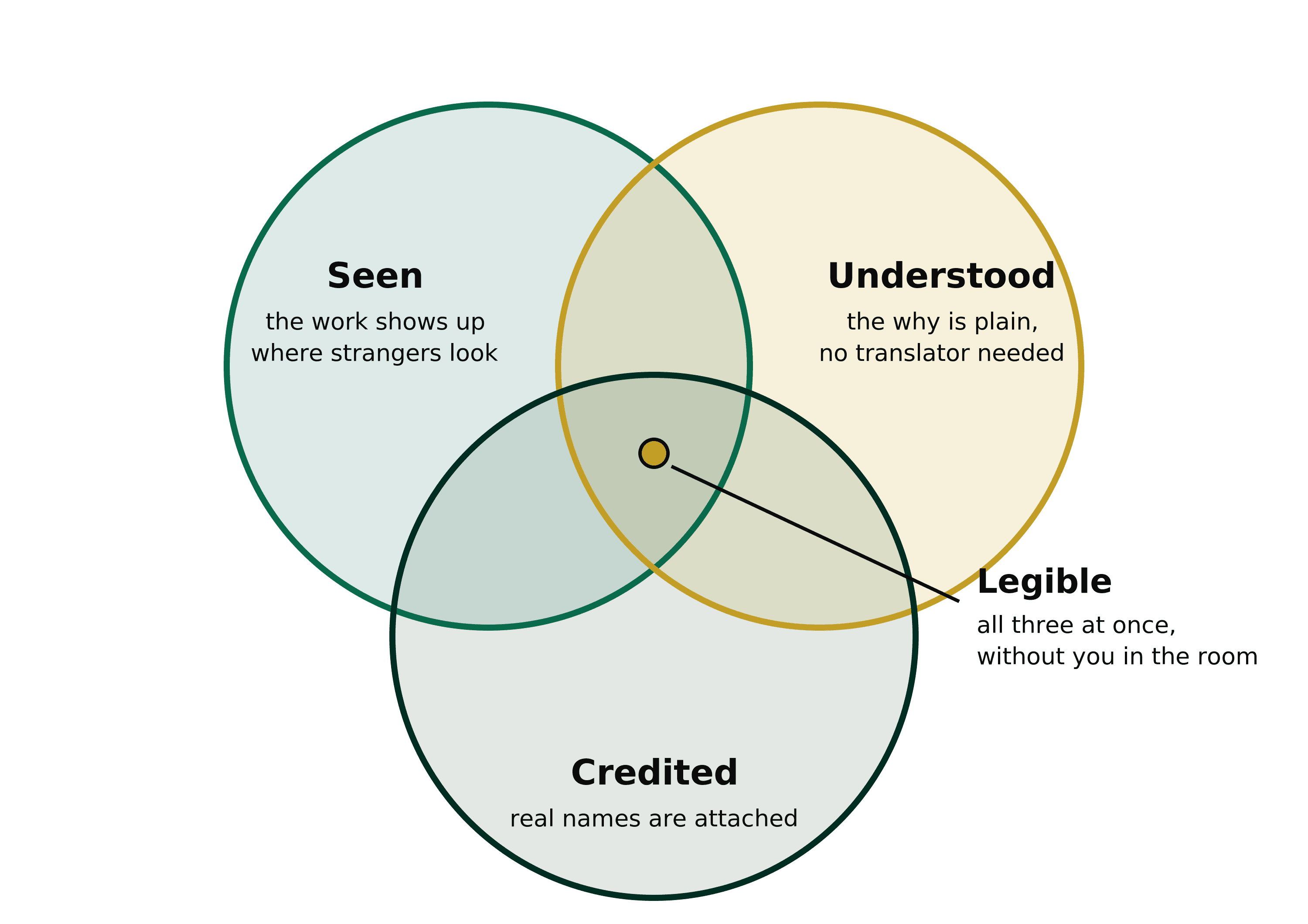
I want to be careful here, because the word visibility makes good people flinch, and I understand why. Legibility is not talking about yourself more. It isn't the weekly humble-brag, the strategic cc, or narrating your own diligence in every channel. Everyone can smell that, and a reorg makes the smell stronger.
Self-promotion makes you more visible. Legibility makes the work more visible. The first needs you present and performing. The second works the night the org chart changes, which is exactly the night you won't be in the room.
The ten-minute stranger test
Here's the test I now run with every team I support.
Imagine someone senior, sharp, and completely new walks in tomorrow. She gets ten minutes alone with whatever your team leaves lying around: the board, the wiki, the last few updates. You're not there to narrate.
What does she walk away knowing? Could she say what you're delivering this quarter? Could she tell why anyone funded it? Would a single human name attach itself to any of it?
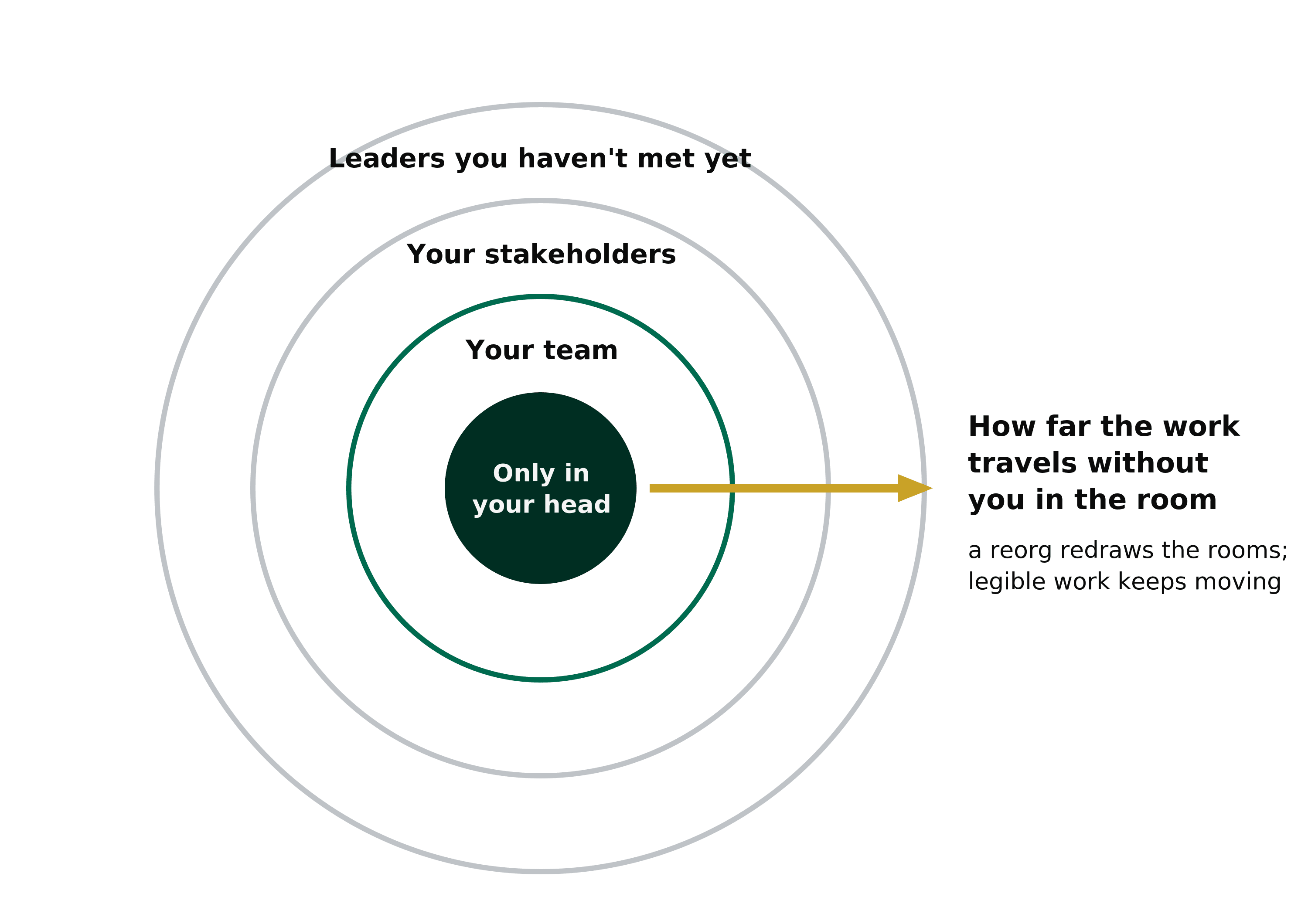
For most teams, the honest answer stings. The work is real, the effort is real, and almost none of it survives contact with a stranger. The context lives in people's heads, in chat threads, in a standup nobody outside the team attends.
That's not a character flaw. It's the default setting. Delivery work is biased toward doing the next thing, not describing the last one. Which is why legibility has to be built as a small weekly habit, not summoned in a panic the week a new VP starts asking around.
What's on the desk when you're not there
Four artifacts carry almost all of the weight. None of them needs an hour a week. Together, they answer the stranger's questions before she asks them.
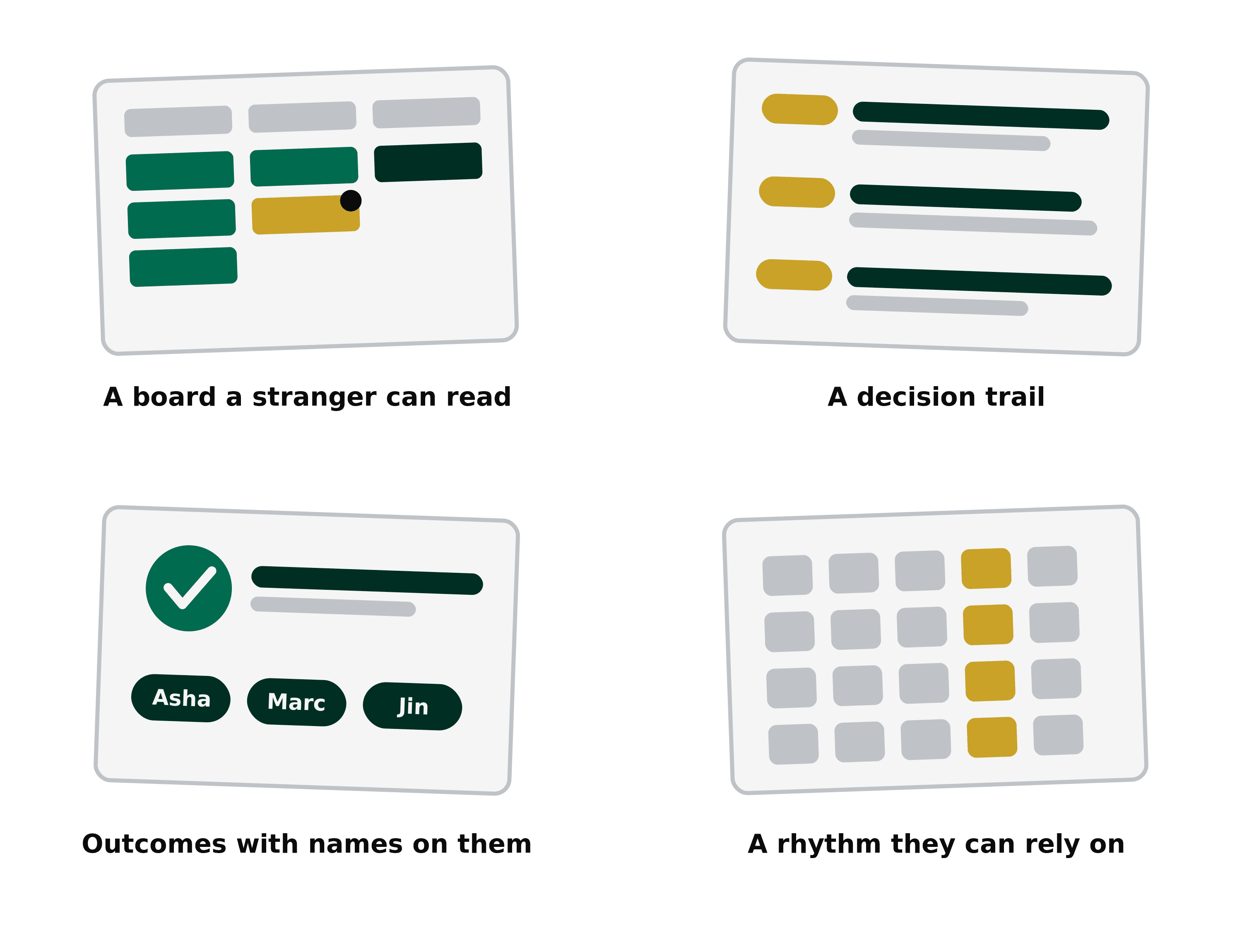
A board a stranger can read
Not a perfect board. A readable one. Columns that mean something to an outsider. Items written in outcome language, like “customers can pay by invoice,” instead of ticket grammar like “BE changes pt 2.” Blockers visible instead of politely hidden.
The test isn't whether your team understands the board. They'd understand a whiteboard covered in inside jokes. The test is whether someone two levels up could read it cold and come away with the shape of the work.
A decision trail
Reorgs don't just move people. They erase context. Six months from now, somebody new will look at a choice your team made, ask why on earth it was done that way, and the people who remember will be scattered across three departments.
So keep a trail. Three lines per decision: what we decided, why, and who was in the room.
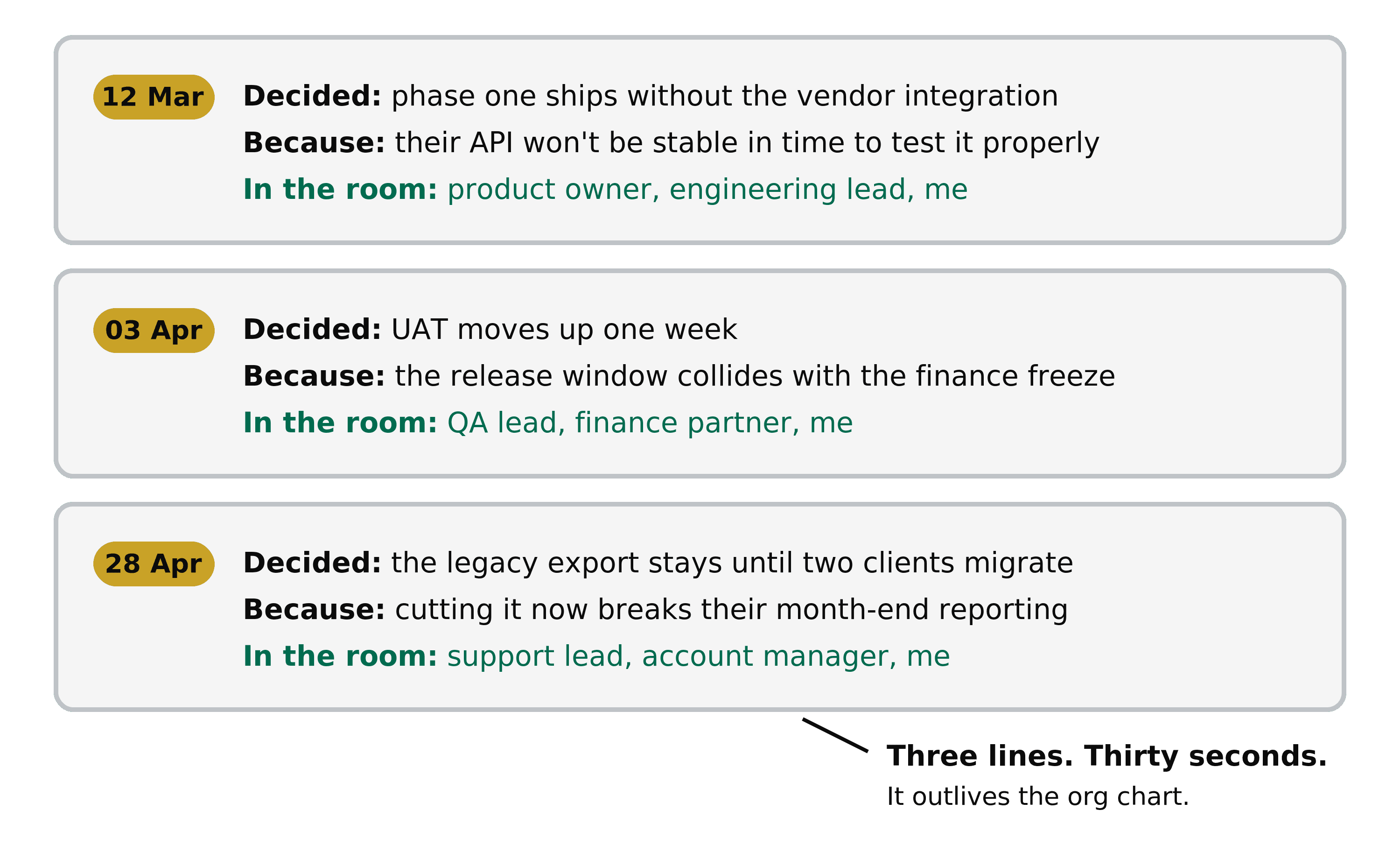
It takes thirty seconds, and it quietly does two jobs. It protects the team from re-litigating settled questions every time leadership changes. And it leaves a long, dated record of you being in the room when the real calls were made. Nobody puts that on a resume. Everybody senior notices it.
Outcomes with names on them
When something finishes, name it, and name the people who made it happen. A short note, a line at the all-hands, a closing comment on the epic.
Here's the part that surprises people: most of the names won't be yours, and that's exactly why it works. Crediting others is the one form of visibility nobody resents. Do it steadily and you become, in everyone's mental map, the person who's across the delivery. You become legible by making other people's work legible. I haven't found a more honest shortcut anywhere.
A rhythm they can rely on
The last habit is the least glamorous: predictability. The same short note, the same day, every time, whether the news is good, bad, or boring.
Don't overthink the prose. This isn't a writing skill; it's a reliability signal. A team that's heard from on a steady rhythm reads as managed. Silence, in an organization under change, never reads as “all fine here.” It reads as “nothing is happening” or “something is being hidden,” and both earn you the wrong kind of attention.
The flinch, and what it gets wrong
Whenever I walk a mentee through this, the same objection surfaces, usually said quietly. “I don't want to be that person. The self-marketer. The one who plays politics instead of doing the job.”
I love that flinch. It usually belongs to the people with the most integrity. It's just aimed at the wrong target.
The performative version claims credit. The legible version assigns it. The performative version appears when leadership is watching. The legible version is the same boring rhythm every week. The performative version survives until someone checks. The legible version is made entirely of things anyone can check.
And here's the uncomfortable truth waiting on the other side of the flinch: opting out of visibility isn't humility. It's choosing to let strangers guess what your work is worth, during the exact weeks when guessing is all anyone has time for. Dev was excellent. The guessing still cost him a year.
Start before you need it
If you're not in the role yet, or your org feels stable, this can sound like a someday skill. It's the opposite. It only works if it's already there when the announcement lands, which means the right week to start is an ordinary one.
And if you're still working toward your first Scrum Master or project role, you have an unusual advantage: you can practice every piece of this without anyone's permission. Running a volunteer project, a community event, a practice build? Keep the readable board. Keep the three-line decision log. Write the monthly note that names outcomes and people. You'll be building the habit, and you'll also be building something better: evidence. “Walk me through how you ran it” is a gift of an interview question when there's a dated decision trail behind your answer instead of an adjective.
For everyone else, start small, this week:
Rewrite the five vaguest items on your board in outcome language.
Start the decision log with the next real decision. No backfilling.
Send one short note naming a finished thing and the people who finished it.
Then keep the rhythm.
Reorgs will keep coming. The org chart was never yours to control. But whether the work can answer for itself when a stranger comes looking, quiet, checkable, already written down: that part has been yours all along.

Subscribe to the Newsletter
Join our growing community and get alerted first on our every article.
*By subscribing, you agree to send your information to our Company who agrees to use it according to their Terms and conditions and Privacy Policy
About the author
I believe the strongest tool and flex each of us has is our belief. When we truly believe in something, we align our mindset, energy, and actions with the right effort and guidance. That is when achieving almost anything becomes possible. This is how I help mentees at OAKKTREEUNII move into Software and Project Management careers for better pay, better confidence, and better work-life balance.
Comments