Is Scrum obsolete? Ask the job boards, not the influencers.
ESTIMATED TIME
10
mins

Written by
Rajveer Prasad
Published on
The people announcing the funeral sell content. The people posting jobs spend money. Trust the spenders.
Every few weeks the post comes around again. Black background, white letters, maximum font: Scrum is dead. Under it, a comment section split between grief and gloating, and somewhere in the middle a career switcher who just spent six months and a chunk of savings on a certification, quietly panicking.
I want to talk to that person.
Last month a mentee sent me one of those posts with a single line attached: “Should I stop?” He’d paused his applications. Not because anyone had rejected him. Because a stranger with a content calendar had told him the role was finished.
Here’s my answer, and it’s the whole argument: when you want to know whether a job is dying, don’t ask the people selling commentary about the job. Ask the people spending money to fill it. The influencers have a take. The job boards have receipts. Right now, they’re telling different stories, and only one of the storytellers loses money for being wrong.
Be fair to the doomers first
An argument you win by ignoring the other side’s best point isn’t won. So give the obituary writers their due, because they aren’t inventing the smoke.
In January 2023, Capital One eliminated about 1,100 roles in its agile job family in a single announcement, saying it would fold agile delivery work directly into its engineering and product teams {Bloomberg, via Banking Dive, 2023}. Other large companies have run quieter versions of the same play. Search “Scrum Master” on a job board today and you’ll find fewer pure, single-title postings than you would have in 2021, and more listings that read like three jobs stapled together. All of that is real. If your entire plan was “get certified, get hired to run ceremonies,” the market has genuinely moved against that plan.
But watch what the obituary writers do with that smoke. They need a fire, weekly, because the feed punishes nuance and pays out on alarm. “Scrum is dead” travels. “Dedicated process roles are consolidating while delivery demand keeps growing” does not travel, even though that’s the sentence the evidence actually supports.
Notice the tell: the obituary never links to a job board. It can’t afford to.
Opinions are free. Postings cost money.
A viral take costs nothing to publish. A job posting is different. Behind every posting, a manager fought a budget cycle for headcount, a recruiter is about to spend weeks of their life screening for it, and a salary is sitting in next year’s plan. A posting is the market saying it under oath.
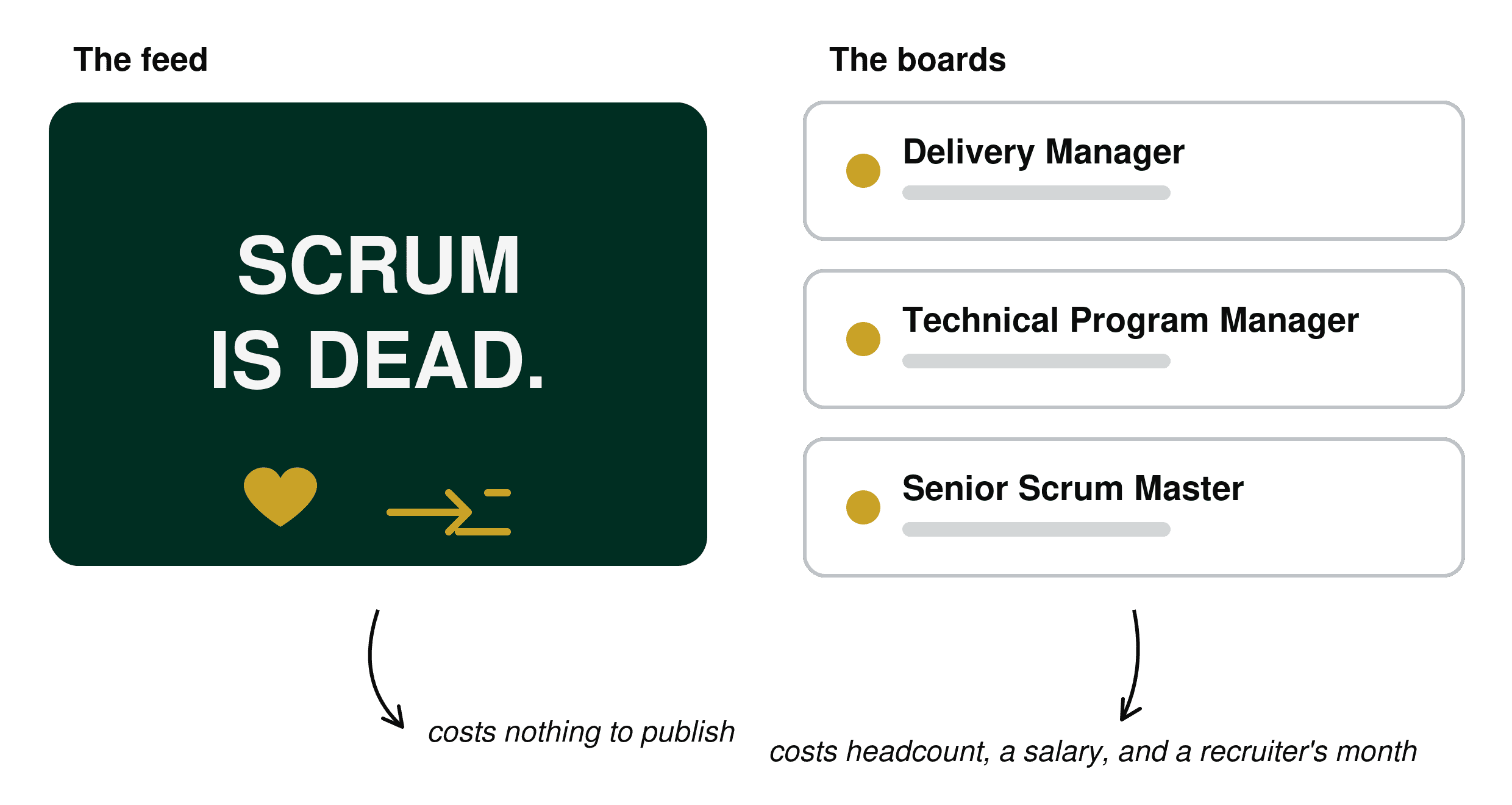
So read the boards as the primary source. Three boring facts fall out, and boring is exactly what you want from career data.
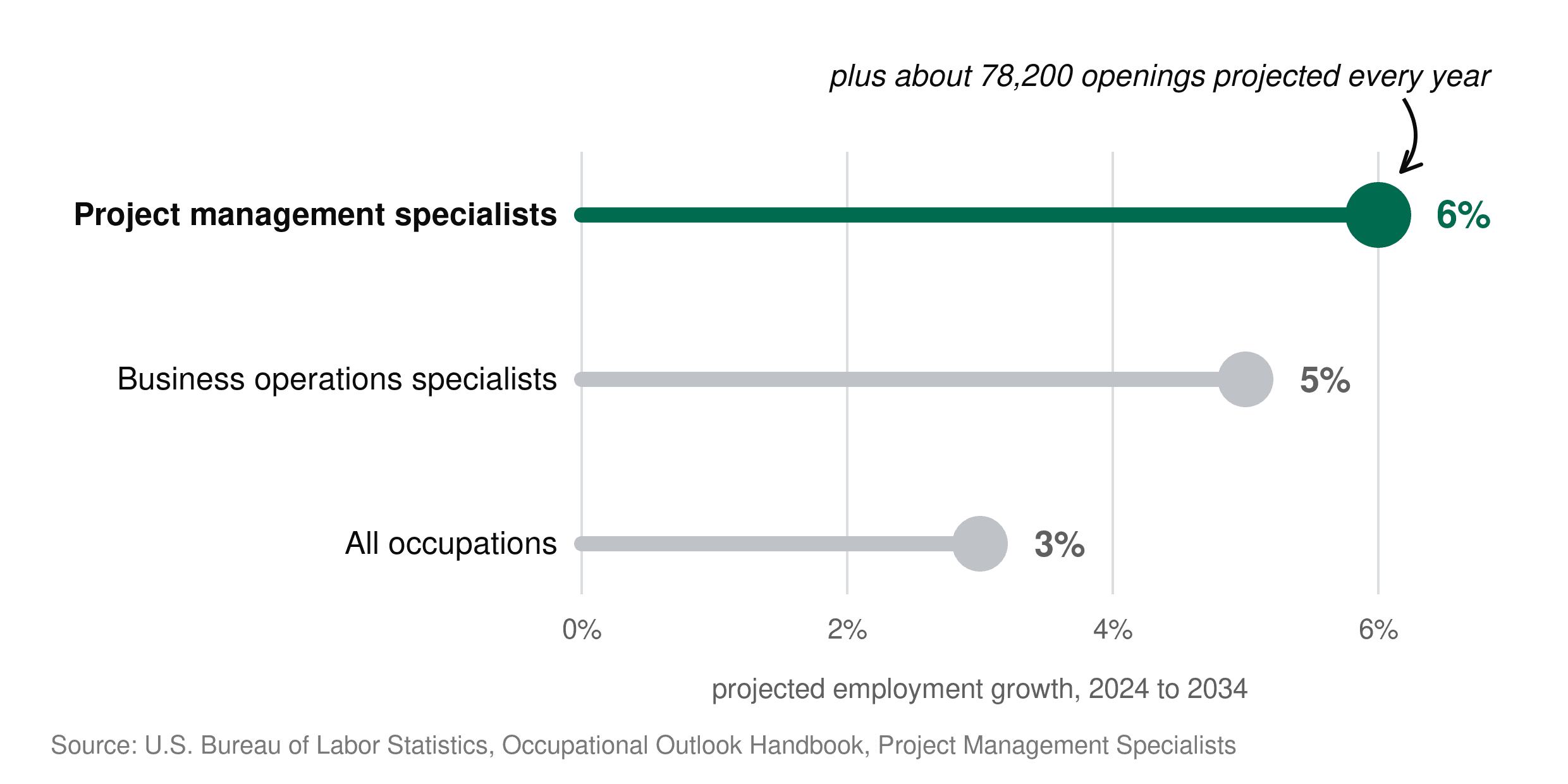
First, the work is growing. The U.S. government doesn’t track “Scrum Master” as its own occupation; the closest official category is project management specialists, the people paid to coordinate scope, schedules, and delivery. That category held just over a million jobs in 2024, is projected to grow 6 percent through 2034, twice the average across all occupations, and is expected to produce about 78,200 openings a year along the way, at a median pay just over $100,000 {U.S. Bureau of Labor Statistics, Occupational Outlook Handbook}. Dying professions don’t generate 78,000 openings a year.
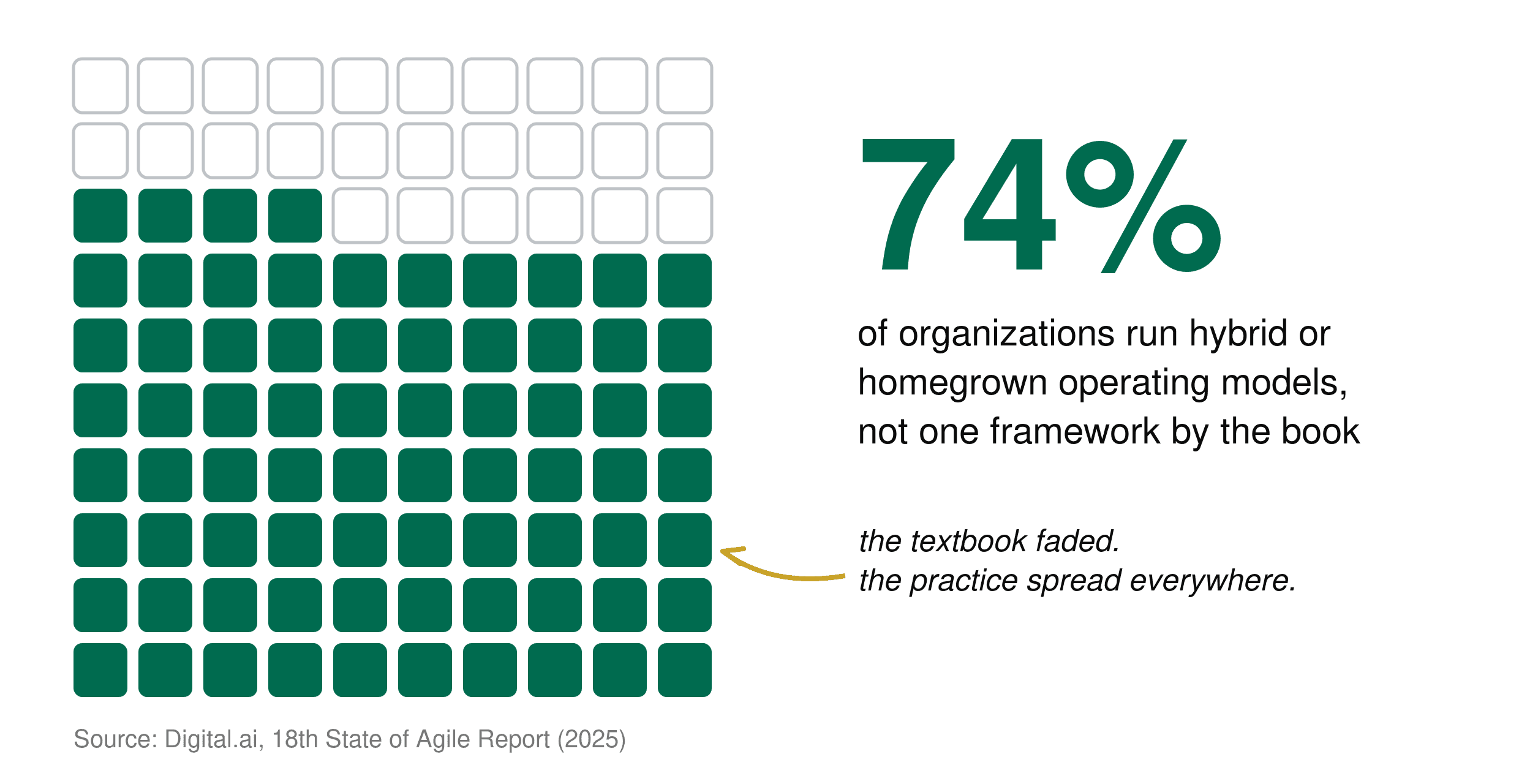
Second, the practice didn’t die. It dissolved into everything. In the latest State of Agile research, 74 percent of organizations say they now run hybrid or homegrown operating models, mixing agile with whatever else helps them ship {Digital.ai, 18th State of Agile Report, 2025}. Read that number the way a hiring manager would. Textbook Scrum, the pure two-week liturgy with every ceremony in its appointed place, is genuinely fading. The thinking inside it is now load-bearing in three quarters of the operating models out there. Methodologies don’t die by disappearing. They die by being absorbed, and absorption is the version where the people who understand them stay employed.
Third, the titles moved. Run your search again under different names: delivery manager, agile delivery lead, technical program manager, release train engineer, senior Scrum Master. Now read the descriptions instead of the titles. Facilitate planning. Manage dependencies across teams. Unblock delivery. Improve flow. Keep stakeholders honest about status. Sound familiar? The work never left the boards. It changed its name tag.
Which means that if your job alert is one saved search for one title string, you aren’t watching the market. You’re watching one shelf of it, and it happens to be the shelf everyone argues about online. The candidates who feel the death of Scrum hardest are usually the ones searching the narrowest.
The version of the role that actually died
Now the uncomfortable part, because the influencers are half right, and the true half deserves a straight look instead of a defensive one.
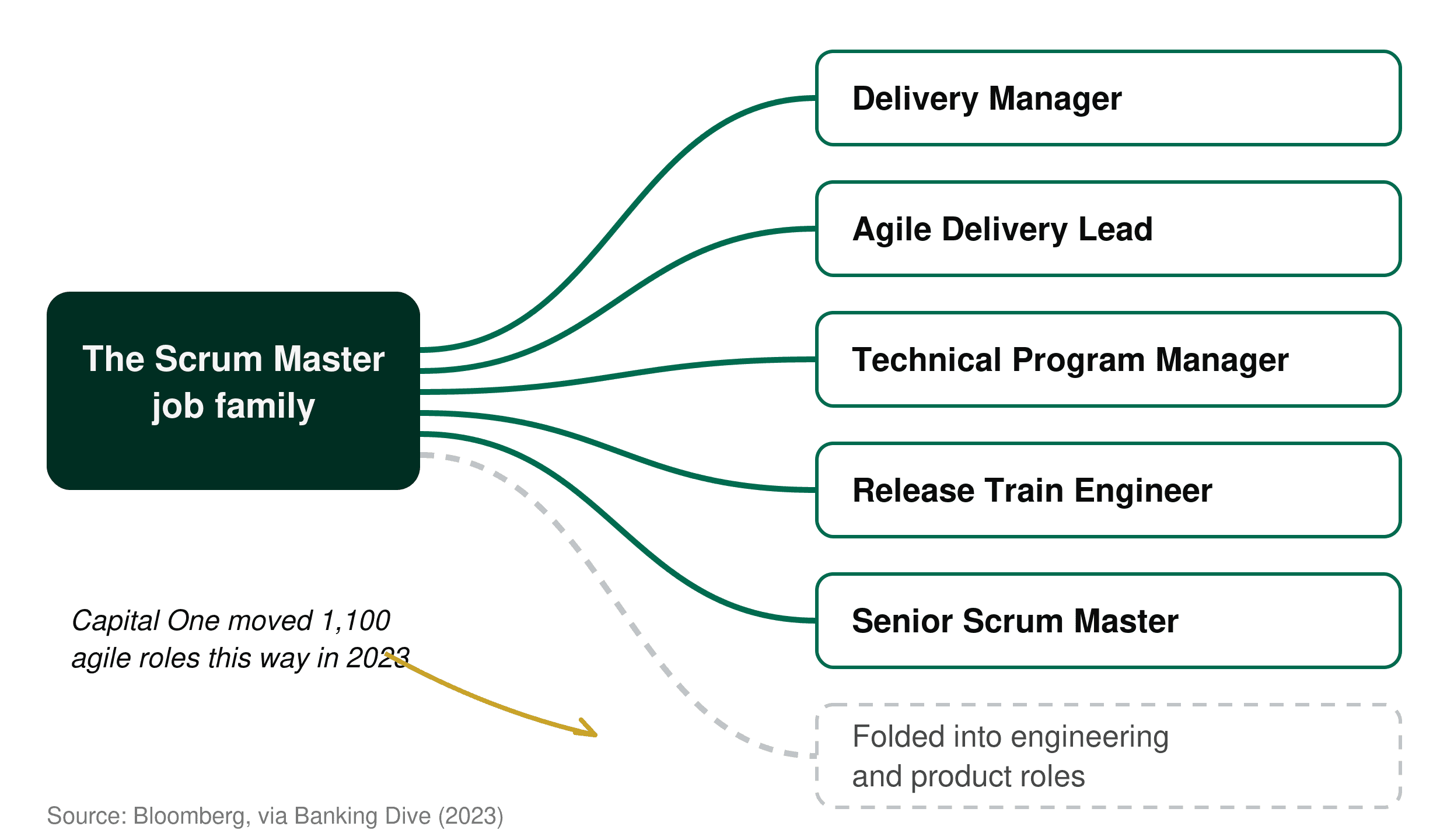
There was a version of this job that deserved to go: the ceremony clerk. Books the standup. Reads the burndown out loud. Updates Jira. Asks “any blockers?” into the silence, types “no blockers” into the notes, and calls that facilitation. That version produced a calendar, not an outcome, and for about a decade companies paid six figures for it. They’ve stopped. Capital One’s own explanation of its cuts says it plainly: the process work moved into the teams doing the delivery.
If you’ve held that version of the role, this stings. But the same fact, read forward, is the most useful career sentence in this whole debate. The market didn’t stop buying delivery competence. It stopped buying delivery administration. Judgment kept its job. The clerk lost his.
And no, none of this means the framework knowledge was wasted. Theory is still the floor. You need the vocabulary just to read those postings intelligently, and an interviewer will absolutely check that the floor exists. But a floor was never going to hold up a career by itself. The ceiling is judgment: what you notice, what you raise early, what you ship anyway. The roles that survived the consolidation are priced on the ceiling.
The strongest version of the counterargument deserves an answer too: maybe the dedicated, facilitation-only role really is shrinking structurally, not just being renamed. Partly true, and I won’t pretend otherwise. Some of those 1,100 Capital One roles weren’t renamed; they were dissolved. Which is exactly why the move isn’t to wait for the old title to come back. It’s to widen what you can credibly offer until the consolidation works in your favor, because when one role absorbs three, the person who can do two of the three gets the seat.
This is why “is Scrum obsolete?” is the wrong question. Scrum was never the asset. It was a container. The asset was always what the container was supposed to produce: visibility, flow, honest forecasting, problems surfaced early, a team that gets better on purpose. Containers go in and out of fashion. Nobody has ever stopped hiring for what this one was built to hold.
Twenty postings, five titles, one list of verbs
So here’s what I told my mentee to do instead of quitting, and what I’d tell you. Stop reading commentary about your market and go read the market. One evening is enough.
Pull twenty current postings across five titles: Scrum Master, delivery manager, agile delivery lead, technical program manager, and project manager where the description mentions agile.
Highlight the verbs, not the nouns. Don’t count how many times “Scrum” appears. Circle facilitate, unblock, forecast, align, de-risk, escalate, communicate.
Tally them. That ranked list of verbs is the real job description of 2026, written by people spending money, not people farming clicks.
Then build evidence against the verbs, not another certificate against a noun. Facilitate a real group anywhere someone will let you. Untangle one real dependency. Run one honest retro and write down what changed.
My mentee did the exercise. He came back with a better question: “Why do half of these ask for stakeholder communication, and why did nobody teach me that?” That’s the question of someone reading his market instead of fearing it. He’s applying again, to more titles than he previously knew to search.
The feed gets paid when you click. The board gets paid when someone gets hired. When the two disagree about your career, trust the one with money on the table.
Scrum isn’t obsolete. The lazy version of the job is. Those are two different funerals. Make sure you know which one has your name on the guest list.
Sources
Bloomberg, via Banking Dive: “Capital One cuts 1,100 tech jobs” (January 2023).
U.S. Bureau of Labor Statistics, Occupational Outlook Handbook: Project Management Specialists (2024 to 2034 projections.
Digital.ai, 18th State of Agile Report (2025), key findings summarized at Scrum.org.

Subscribe to the Newsletter
Join our growing community and get alerted first on our every article.
*By subscribing, you agree to send your information to our Company who agrees to use it according to their Terms and conditions and Privacy Policy
About the author
With 20 years guiding high-stakes Agile transformations, I turn theory into action at Oaktreeuni—mentoring aspiring Scrum Masters to think critically, adapt fast, and lead beyond frameworks. The payoff? You step into a high-paying Scrum Master or Agile PM role already equipped to excel.
Comments