The interview question everyone fumbles: ’tell me about a conflict’
ESTIMATED TIME
8
mins

Written by
Rajveer Prasad
Published on
They're not asking for a war story. They're checking whether you can disagree without burning the bridge.
Almost everyone has a bad answer ready for this one. You feel it coming in a behavioral interview, and you reach for the safe story: a small disagreement that more or less resolved itself, where you stayed calm, stayed reasonable, and turned out to be right. It sounds fine. It also tells the interviewer nothing, which is its own kind of red flag.
Here's what's actually happening. Tell me about a time you had a conflict is one of the most revealing questions in the room, and most candidates treat it like a trap to escape from instead of the open door it is.
The instinct to sand the story smooth makes sense. Nobody wants to sound difficult, especially when you're trying to get hired. So people pick the blandest disagreement they can find and round off every sharp edge. The problem is that the sharp edges are the answer. An interviewer asking about conflict already knows the job is full of it. What they don't know yet is what you're like when it shows up.
Why they keep asking it
Behavioural questions like this one aren't filler between the technical bits. They're the part of the interview that actually predicts the job. Google's own hiring research is blunt about it: structured behavioral questions, the tell-me-about-a-time kind, are more predictive of on-the-job performance than an interviewer's gut, because how you behaved before is the best signal anyone has for how you'll behave next {Google re:Work}. They're not curious about your story. They're using your story to forecast how you'll act when it gets hard on their team.
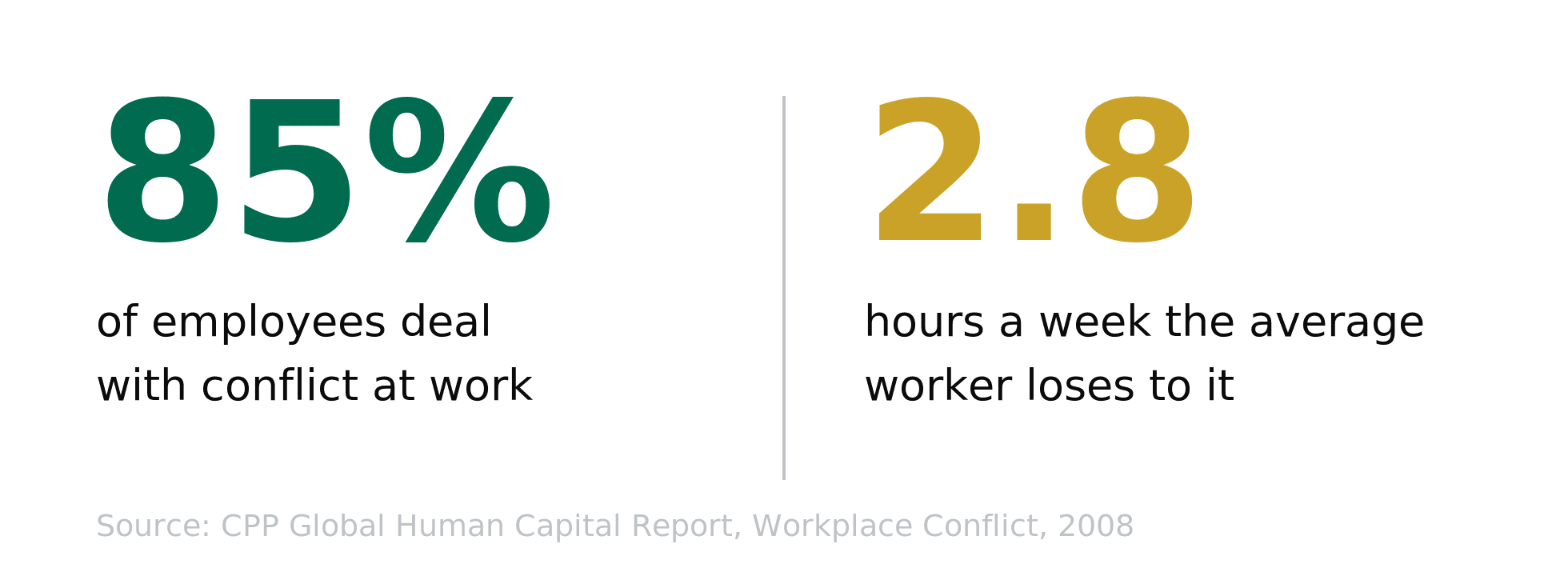
And it will get hard. Conflict isn't an edge case in delivery work, it's the weather. In one large international study, 85% of employees said they deal with workplace conflict to some degree, and the average worker burns close to three hours a week on it {CPP Global 2008}. So a Scrum Master or PM who can't handle tension isn't a small gap to coach later. It's a disqualifier, because handling tension is most of the actual job.
The four ways people fumble it
Most weak answers fail in one of four predictable ways, and interviewers have heard every one of them.
The too-trivial one. We disagreed about a meeting time. It dodges the question, and it reads as I avoid real conflict, or I don't even notice it.
The hero who was right. You push, you escalate, you win, the other person folds. It feels strong and lands badly, because now they're picturing being on the other side of you.
The blame story. The whole thing was someone else's fault and you were the only adult in the room. Nobody believes it, and it shows you can't see your own part.
The avoider. I kept my head down and it blew over. That's not resolution. That's hoping, and hoping doesn't ship.
Notice the pattern. Each of these quietly answers a different question than the one you were asked, and each signals exactly the thing you don't want to signal. The trivial one says you don't engage. The hero one says you're exhausting to disagree with. The blame one says you lack self-awareness. The avoider says you let problems fester. None of those is the person they're trying to hire, and all of them are avoidable once you know what the question is really for.
What they're really scoring
Decode the question and it gets a lot easier. When someone asks about a conflict, they're listening for three things, and which side won is not one of them.
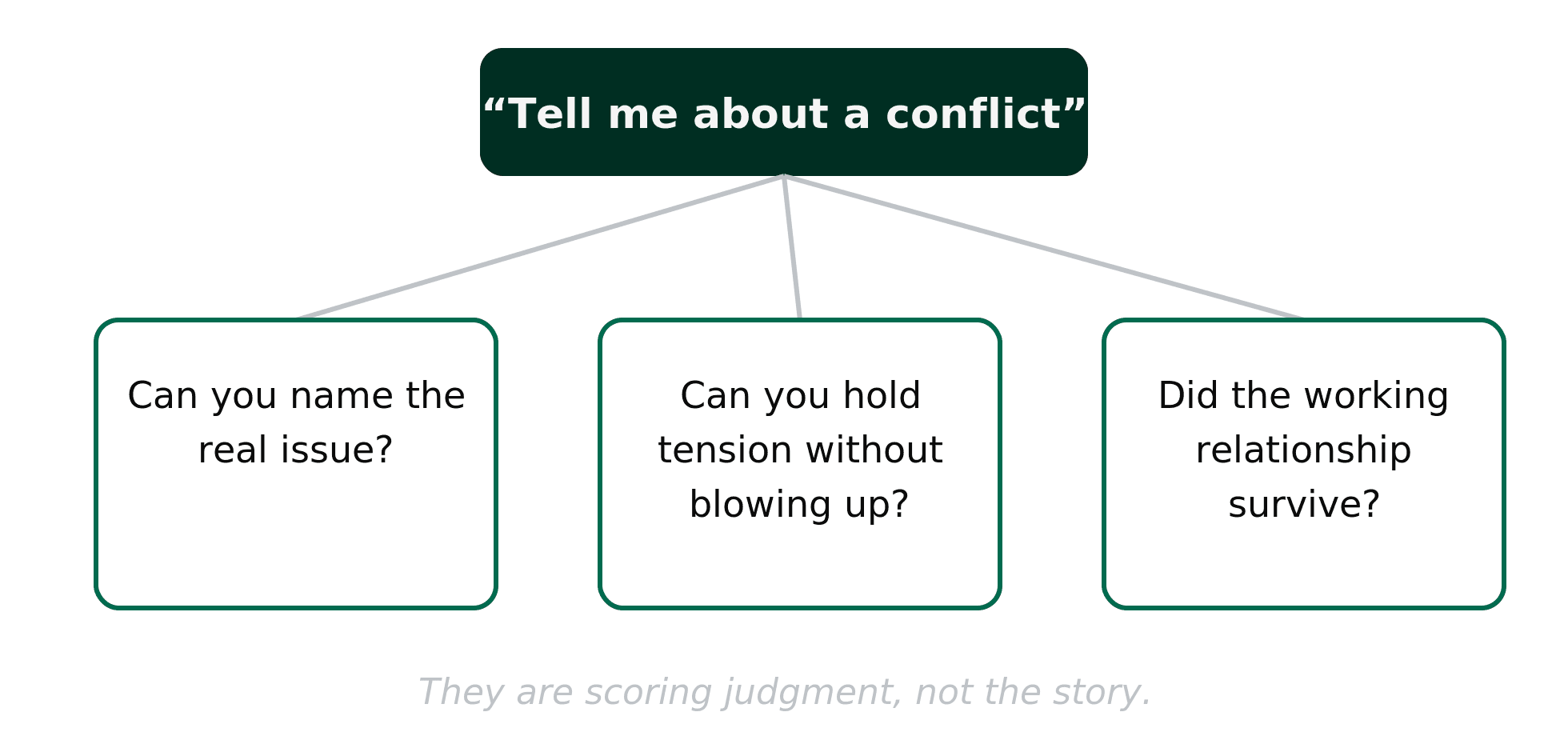
Can you name the real issue, instead of talking around it? Can you stay in the tension long enough to work it, without exploding or caving? And did the working relationship survive, so the two of you could still build something together the next week? That last one is the quiet test almost everyone misses. Anyone can win an argument by steamrolling. The senior move is to disagree hard and keep the person on your side.
Think about what holding tension actually looks like. A developer insists a feature is impossible by the deadline. The weak instinct is to either back down immediately or push until they cave. Holding the tension is the harder, more useful third thing: staying in the conversation long enough to find out whether it's truly impossible, or impossible at the current scope, or impossible because of a dependency nobody flagged. You don't win that exchange. You work it. And the interviewer can hear, in how you describe it, whether you're someone who can sit in an uncomfortable conversation without either flinching or detonating.
A structure that actually lands
You've probably been taught STAR: situation, task, action, result. It's fine scaffolding, but for a conflict story it's missing the beat that matters most. Use this shape instead.
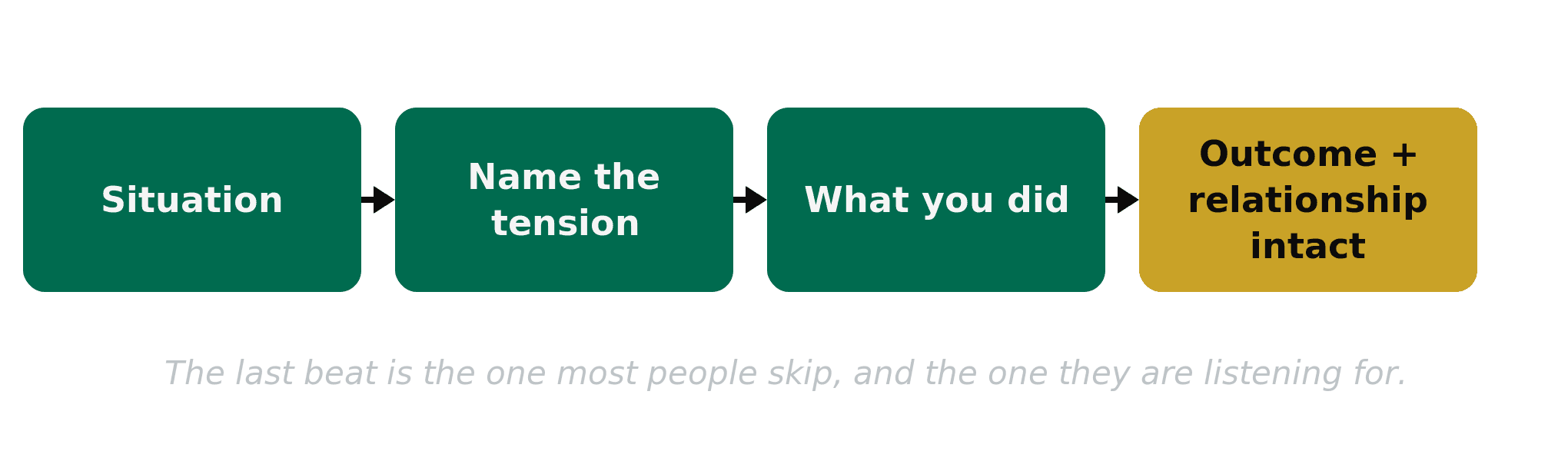
Set the situation in a line. Name the tension honestly, including what the other person actually wanted, not a strawman version you can knock down. Say what you specifically did, the real moves, not I communicated. Then land the outcome, and make sure the outcome includes the relationship, not just the deliverable. We hit the date is half an answer. We hit the date, and he's the first person I'd want on my next project is the whole one.
The honesty in beat two is what separates a real answer from a rehearsed one. When you can say the other person wasn't being difficult, they were protecting something that mattered to them, a quality bar, a commitment they'd made, a risk they could see and you couldn't, the interviewer relaxes. That single move tells them you don't turn colleagues into villains the moment they get in your way. It's also just true to how good conflicts actually resolve, which is why it's the easiest part to deliver convincingly: you're describing a person you respected, not one you defeated.
Weak answer, strong answer
Here's the difference in practice, same situation, same length.
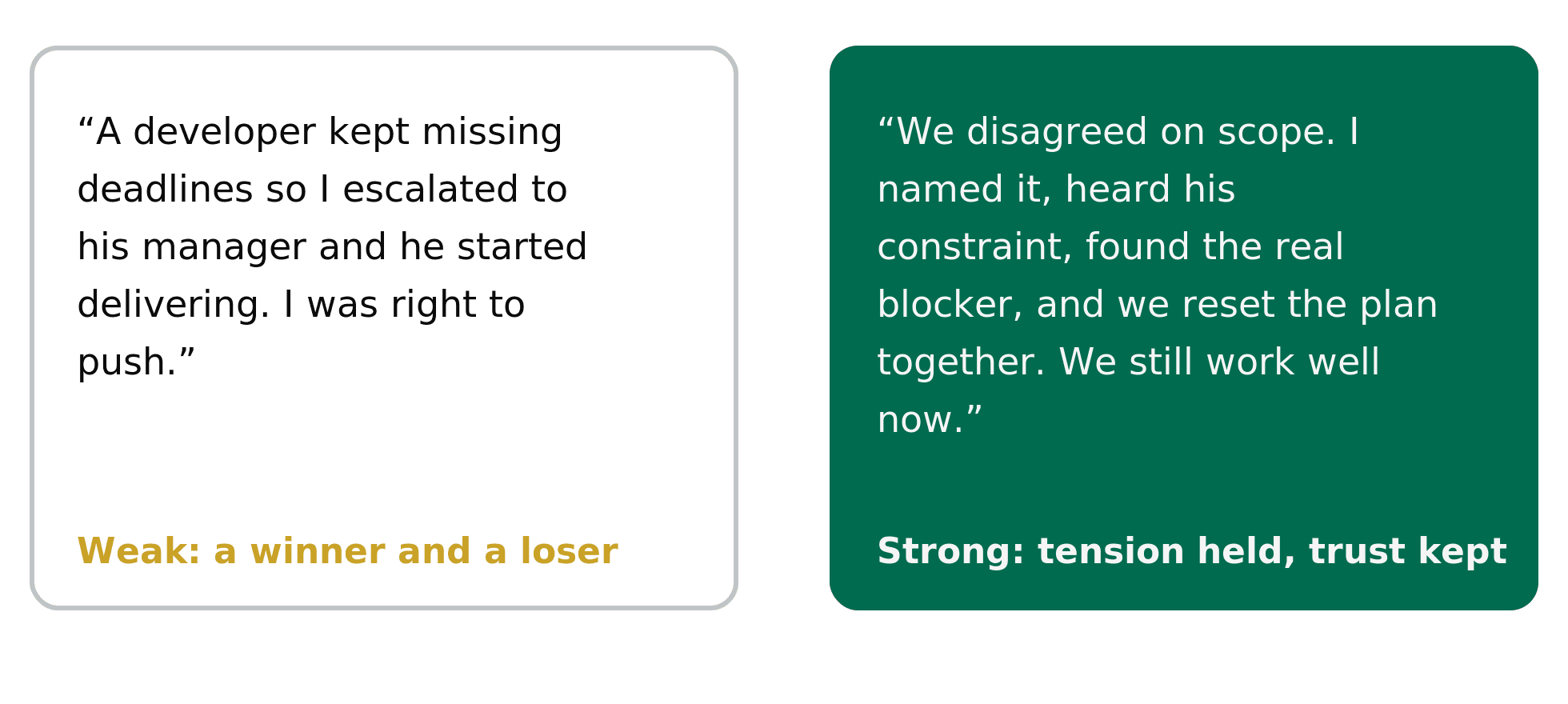
The first one has a winner and a loser, and in the interviewer's head they're now standing next to the loser. The second names the disagreement, treats the other person as reasonable, digs out the real blocker under the surface, and ends with the relationship intact. One answer says I'm right a lot. The other says I'm safe to put in a room when things are tense. The second is what they're actually buying.
Go build the answer, for real
Two things to do before your next interview. First, pick a real conflict, not the safe one. A genuine disagreement where you and a smart person wanted different things for good reasons. Those are the ones that show judgment. And if you don't have one yet because you're early in this, go get one: facilitate a real team, run a retro with something contentious actually on the table, own a decision someone pushes back on. You can't fake the texture of a real disagreement, and the good news is you don't have to. You can go build it this month.
Second, write it in the four beats and say it out loud. Cut the part where you were right. Add the part where the relationship held. Practice until naming the tension feels normal instead of dangerous, because the calm in your voice when you describe a hard moment is half of what they're scoring.
Get this one right and you stop dreading the question altogether. It turns into the place you prove you can do the real job: have the hard conversation, and keep the people.
Sources
Google re:Work. "A guide to structured interviewing for better hiring practices".
CPP Global Human Capital Report. "Workplace Conflict and How Businesses Can Harness It to Thrive" (2008)

Subscribe to the Newsletter
Join our growing community and get alerted first on our every article.
*By subscribing, you agree to send your information to our Company who agrees to use it according to their Terms and conditions and Privacy Policy
About the author
With 20 years guiding high-stakes Agile transformations, I turn theory into action at Oaktreeuni—mentoring aspiring Scrum Masters to think critically, adapt fast, and lead beyond frameworks. The payoff? You step into a high-paying Scrum Master or Agile PM role already equipped to excel.
Comments