How to brief an executive in three sentences
ESTIMATED TIME
5
mins

Written by
Rajveer Prasad
Published on
If you need more than three, you don't understand the project yet.
Here's a test you can run on yourself right now. Take your current project. Brief it to an executive in three sentences. Not three paragraphs. Three sentences.
If you can't, the problem isn't the format. It's that you don't yet understand your own project well enough to say what actually matters. The detail you want to cram in is a security blanket, and executives can smell it from across the table.
The ability to compress is not a presentation trick. It's the clearest evidence that you genuinely understand the thing.
Who you're actually briefing
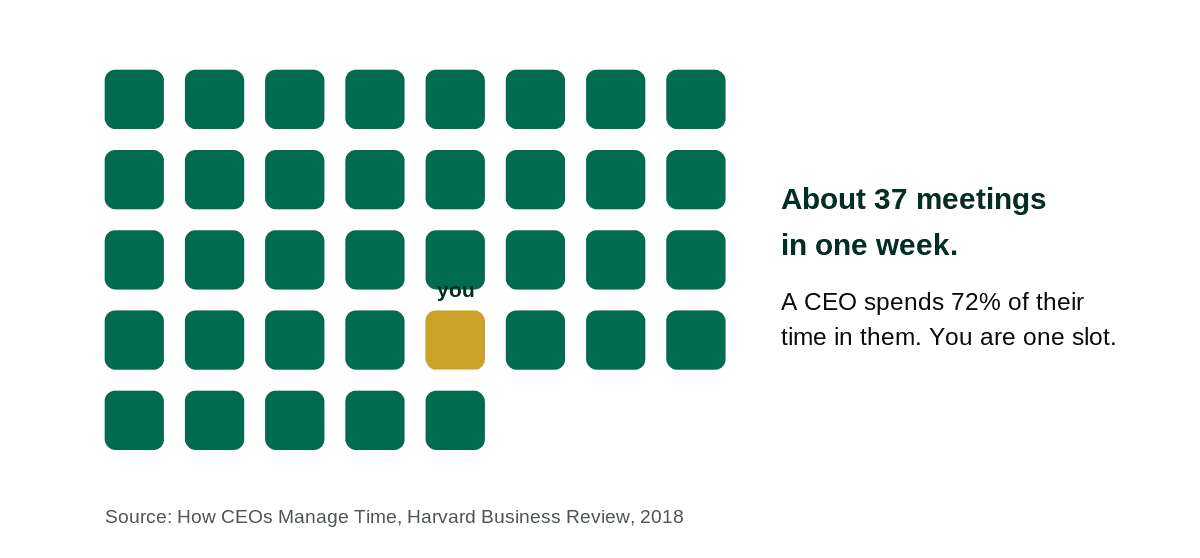
Start by being honest about the person across from you. They are not waiting for your update with a fresh notepad and an open afternoon. A Harvard Business Review study that tracked CEOs found they spend 72 percent of their working time in meetings, roughly 37 of them in a single week {Harvard Business Review, 2018}. You are not the meeting. You are a slot. Possibly the twenty-ninth one since Monday.
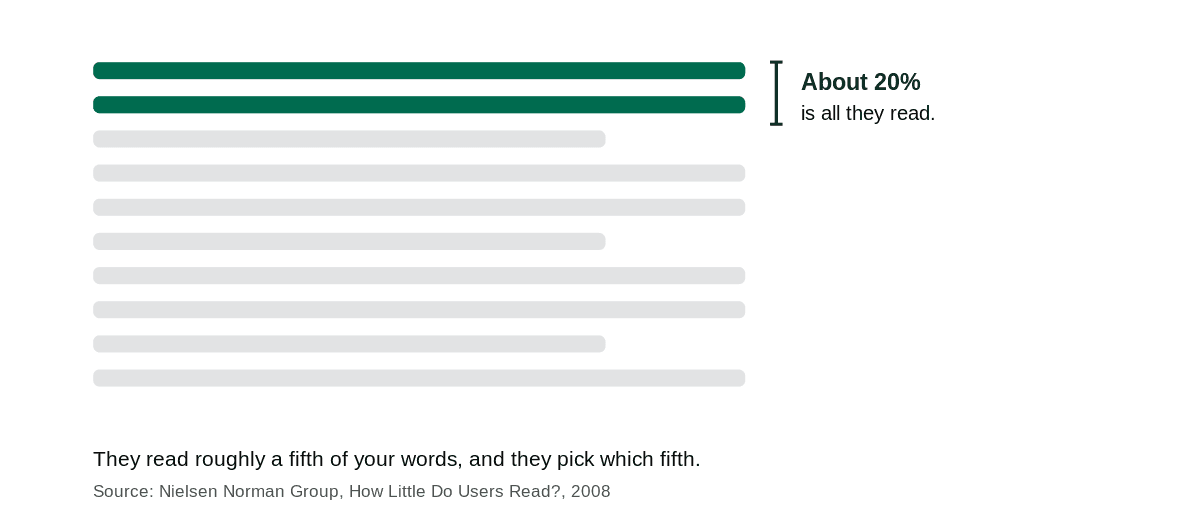
And they will not read their way out of it, either. Nielsen Norman Group, measuring how people actually consume text, found that on a typical page users read at most 28 percent of the words, and 20 percent is the more honest figure {Nielsen Norman Group, 2008}. Your careful six-paragraph status update? They're reading a fifth of it, and they're choosing which fifth. Lead with the wrong sentence and the four-fifths they skip is the part that mattered.
So the executive isn't being rude when they cut you off at sentence two. They're rationing the scarcest thing they own, attention, across more demands than you can see. Respect that, and you instantly sound more senior than the person who makes them dig for the point.
The three sentences
Here's the structure that survives a busy room. Three sentences, in this order.
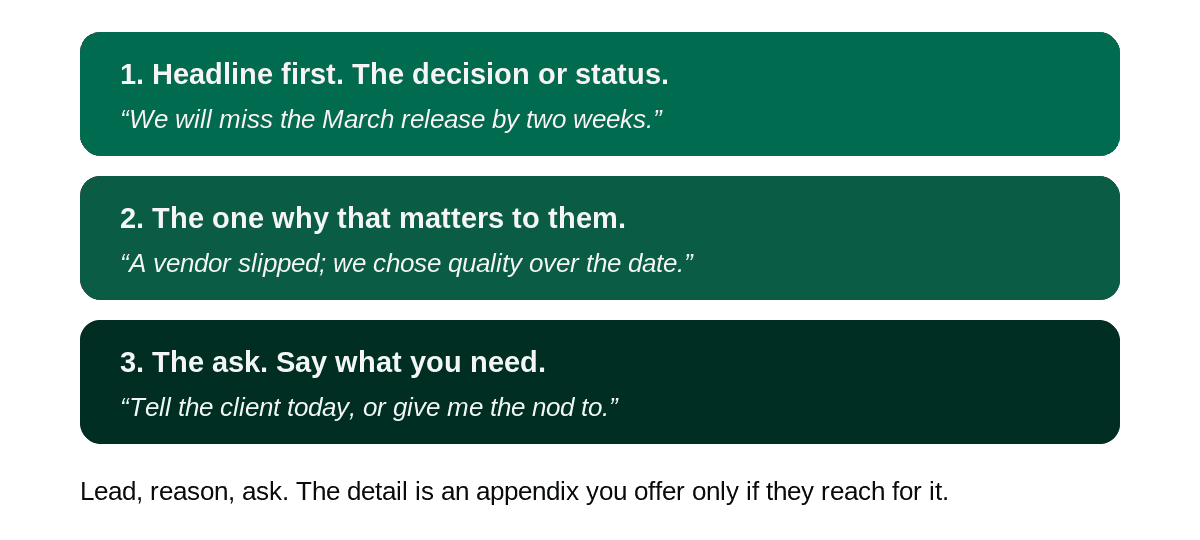
One: the headline. The decision, the status, or the ask, stated first, in plain words. “We'll miss the March release by two weeks.” Not the story of how you got there. The end of the story, up front.
Two: the why that matters to them. One sentence of cause, in their currency, not yours. “A vendor dependency slipped, and we chose to protect quality over the date.” Not the Jira archaeology. The reason a decision-maker actually needs.
Three: the ask. What you need from them, said out loud. “I need you to tell the client today, or give me the nod to do it.” Most updates die right here, because the briefer never names what they want. The executive's silent question through your entire update is the same four words: what do you want?
Lead, reason, ask. Everything else is an appendix you offer only if they reach for it.
Here's the same update, both ways. The version that loses the room: “So we kicked off the vendor integration three sprints ago, there were some environment issues, then QA flagged a few things, and the vendor has been slow on their side, so we've been working through it, and I think we might be looking at a bit of a delay, but I wanted to flag it.” By sentence two, the executive has quietly moved on. Now the version that lands: “We'll miss the March release by two weeks. A vendor dependency slipped and we chose to protect quality over the date. I need you to tell the client today, or approve me doing it.” Same facts. One sounds like someone drowning. The other sounds like someone holding a problem on purpose.
And notice the most common way this goes wrong. It isn't length, it's order. People bury the headline at the bottom, after the windup, as if they have to earn it. By the time they get there, the listener has already written their own headline, usually a worse one. Put the conclusion first. You're not building suspense. You're handing a decision-maker what they need to decide.
But surely they want the detail
This is the objection every careful person raises, and it deserves a real answer. Doesn't leading with the headline bury the nuance? Doesn't the executive need the full picture to decide well?
Sometimes, yes. So you bring the detail. You just don't open with it. The full picture lives one question away, in the doc, in the appendix, in your answer to “what's driving the slip?” The discipline isn't deleting the detail. It's refusing to make the busiest person in the building mine for the headline. If they want depth, they'll ask, and then you look prepared rather than lost. Leading with the point isn't dumbing it down. It's doing the thinking for them instead of making them do it for you.
When an executive genuinely wants the whole walk-through, they'll tell you, and that's a gift, because now you're answering a question they asked instead of broadcasting at a room that never did. Briefing short doesn't mean you have less to say. It means you let them pull the depth they want, instead of pushing all of it and hoping some of it sticks.
And notice what the three-sentence test quietly forces on you. You can't write the headline until you know what the headline is. You can't name the one why until you've sorted the real cause from the noise. The compression does the thinking. That's exactly why it's hard, and exactly why it reads as senior.
So here's the move, for your next update and your next interview both. Before you walk in, write the three sentences. Headline, reason, ask. If you can't, you're not ready to brief. You're ready to ramble, and that's a difference the room will clock in about ten seconds.
In an interview it shows up the instant they say “walk me through a project.” The junior tells the whole saga. The one who gets the offer gives the headline, the reason, and the result, then stops to see what you want more of. Same project. One sounds like a status report. The other sounds like someone who belongs in the room where the decisions get made.
Sources
Porter, Michael E., and Nitin Nohria. “How CEOs Manage Time.” Harvard Business Review, 2018. hbr.org
Nielsen, Jakob. “How Little Do Users Read?” Nielsen Norman Group, 2008. nngroup.com

Subscribe to the Newsletter
Join our growing community and get alerted first on our every article.
*By subscribing, you agree to send your information to our Company who agrees to use it according to their Terms and conditions and Privacy Policy
About the author
With 20 years guiding high-stakes Agile transformations, I turn theory into action at Oaktreeuni—mentoring aspiring Scrum Masters to think critically, adapt fast, and lead beyond frameworks. The payoff? You step into a high-paying Scrum Master or Agile PM role already equipped to excel.
Comments