How decisions really get made (and why the meeting is theatre)
ESTIMATED TIME
5
mins

Written by
Rajveer Prasad
Published on
The decision was usually made before you walked in. If you only play in the room, you're always reacting.
You've sat in this meeting. A “decision meeting.” Everyone presents, there's some discussion, and then the group decides to do exactly what the senior person clearly wanted before anyone sat down. You watched a decision get made. Except you didn't. You watched one get ratified. The deciding happened two days earlier, in a hallway and a couple of messages you weren't part of.
Most real decisions are made before the meeting. The meeting is where they get performed.
The meeting was never where the deciding happens
Start with what the formal process actually delivers, because it isn't crisp decisions. McKinsey surveyed more than 1,200 executives about how their organizations decide. Only 20 percent said their company is even good at it. A majority said most of the time they pour into decision-making is wasted: 68 percent of middle managers and 57 percent of the C-suite {McKinsey, 2019}.
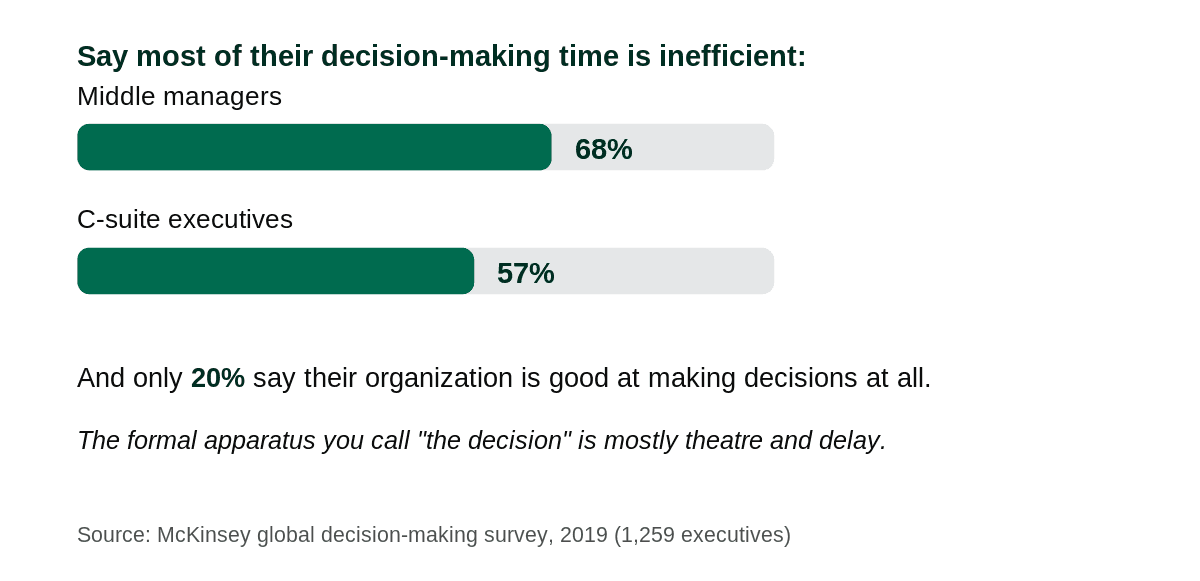
Sit with that. The official apparatus, the governance meeting, the steering committee, the big recurring sync, is described by the people inside it as mostly theatre and delay. If that were really where decisions got made, organizations would seize up. They don't. So the real deciding is happening somewhere else.
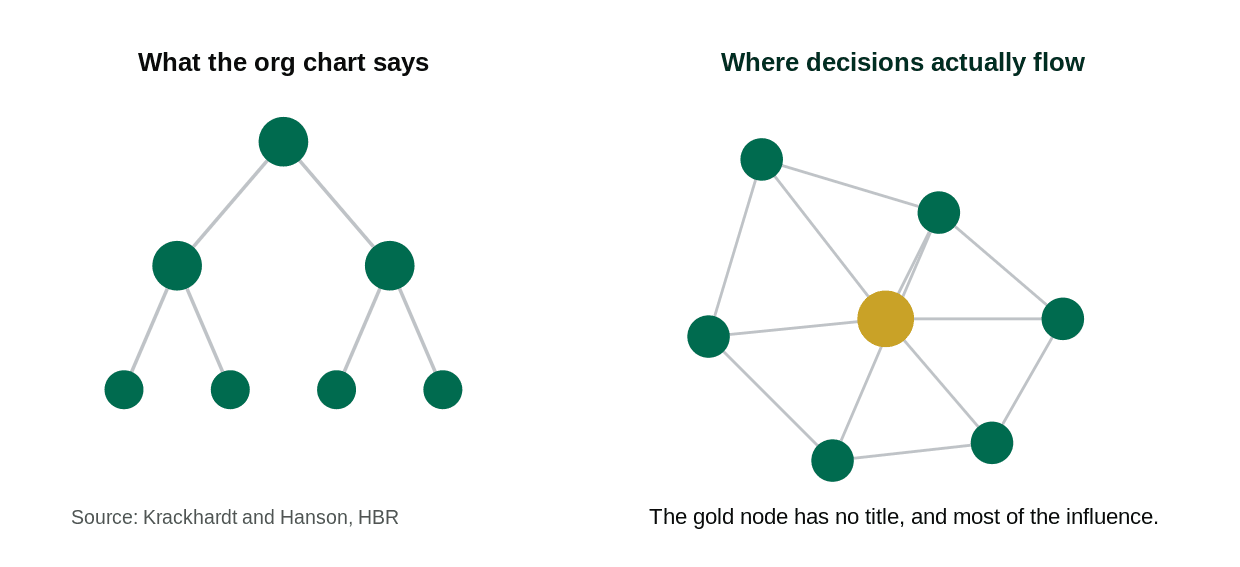
And we know roughly where. Decades of research into how work actually moves through companies keeps landing on the same finding: the org chart doesn't explain it. Influence and information travel through informal networks, the side conversations and trusted relationships that no reporting line captures {Krackhardt and Hanson, HBR}. The person who shapes a decision is frequently not the one with the senior title. It's the one three other people quietly check with first.
Why the room is theatre, and that's not an insult
Here's where people turn cynical, and they shouldn't. Calling the meeting theatre sounds like an accusation. It isn't. The performance does real work.
Groups don't like to make risky calls live, in front of each other, with no idea who's actually on board. It's exposing. So humans do the risky part privately, one relationship at a time, and use the meeting to confirm the alignment that was already built. The room surfaces consensus, spreads ownership, and gives everyone cover to commit. That's genuinely useful. It just isn't where the choosing happens.
The honest objection: surely some decisions really do get made in the room. True. New information lands, someone changes their mind, a real debate breaks out and tips it. It happens. But it's the exception, and notice what makes it the exception. It only works when the alignment wasn't locked in beforehand. The more something matters, the more likely the deciding already happened before anyone clicked join.
What this means for you
If you only operate inside the meeting, you've quietly accepted a losing position. You walk in to react to decisions shaped without you, then wonder why your sharp point in the room never seems to move anything. It doesn't move anything because the room isn't the lever. The lever was the day before.
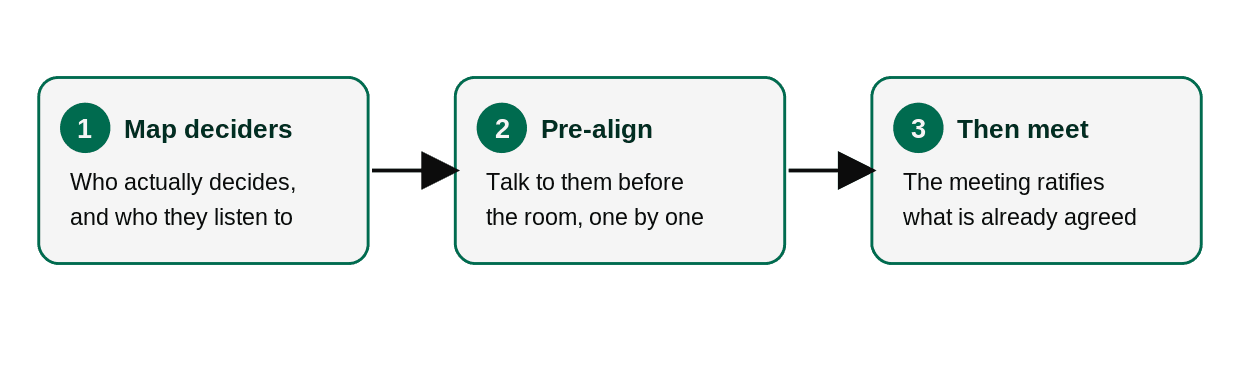
So work the actual process. Before the meeting, find the people who genuinely decide and the ones they listen to, which are not always the obvious names. Talk to them one at a time. Float the idea, hear the objection while it's still cheap to fix, adjust. Then walk into the room with the alignment already built, so the meeting can do what it's really for: ratify, and hand everyone the cover to commit.
Finding the real deciders takes a little watching. Notice who people glance at before they answer. Notice whose name shows up as “let me just check with,” even though they're not in charge of anything. Notice who can kill an idea with a shrug, and who has to escalate to do the same. Titles tell you who's accountable. Behavior tells you who's influential, and those are very often different people. Map the second set, because that's the one that actually decides.
A concrete version. I once watched two people pitch competing approaches to the same steering group. The first built a gorgeous deck and unveiled it cold in the meeting. The second spent the prior week having coffees: asked the budget owner what worried them and adjusted the plan to answer it, checked the timeline with the engineering lead, and let the loudest skeptic poke holes in private, so there was nothing left to prove in public. By the time the meeting ran, that skeptic was nodding along and the budget owner introduced the plan as “the one that actually addresses my concern.” The first person never understood why their better-looking deck lost. They were the only one in the room who hadn't done the real work.
This is the part that gets mislabeled as politics and dismissed by people who then wonder why they have no influence. There's a real line. Manipulation is getting someone to agree to something against their interest by hiding the ball. Pre-alignment is doing your stakeholders the courtesy of hearing their concerns before you ask them to commit in public. One is a trick. The other is just respect, delivered early. Confusing the two is how thoughtful people talk themselves out of ever having any pull.
Do the work backstage
None of this means abandon the meeting or stop making your case in it. It means stop treating the meeting as the place where you win. By the time the room convenes, the work that decides the outcome is mostly already done. Your only real job is to have been the one who did it.
It even shows up in interviews. Ask a junior how they got a tough call approved and you'll hear about the brilliant deck they presented. Ask someone who has actually moved decisions and they'll tell you who they talked to first, what they heard, and how the meeting was basically a formality by the time it ran. One was performing in the theatre. The other understood it was theatre, and did the real work backstage. Go do the work backstage.
Sources
McKinsey. “Decision making in the age of urgency.” 2019. mckinsey.com
Krackhardt, David, and Jeffrey R. Hanson. “Informal Networks: The Company Behind the Chart.” Harvard Business Review, 1993. hbr.org

Subscribe to the Newsletter
Join our growing community and get alerted first on our every article.
*By subscribing, you agree to send your information to our Company who agrees to use it according to their Terms and conditions and Privacy Policy
About the author
With 20 years guiding high-stakes Agile transformations, I turn theory into action at Oaktreeuni—mentoring aspiring Scrum Masters to think critically, adapt fast, and lead beyond frameworks. The payoff? You step into a high-paying Scrum Master or Agile PM role already equipped to excel.
Comments