Your first 90 days as a Scrum Master: what to actually do
ESTIMATED TIME
8
mins

Written by
Shikha Prasad
Published on
Nobody is going to hand you a plan. Here's the arc that earns trust instead of burning it.
The first week of my first delivery role, I sat and waited for someone to tell me what to do. I had a laptop, a calendar full of meetings I didn't understand, and a nagging sense that I was supposed to be adding value immediately. Nobody handed me a plan. I assumed that was a failure of my onboarding. Years later, I learned it's just the default.
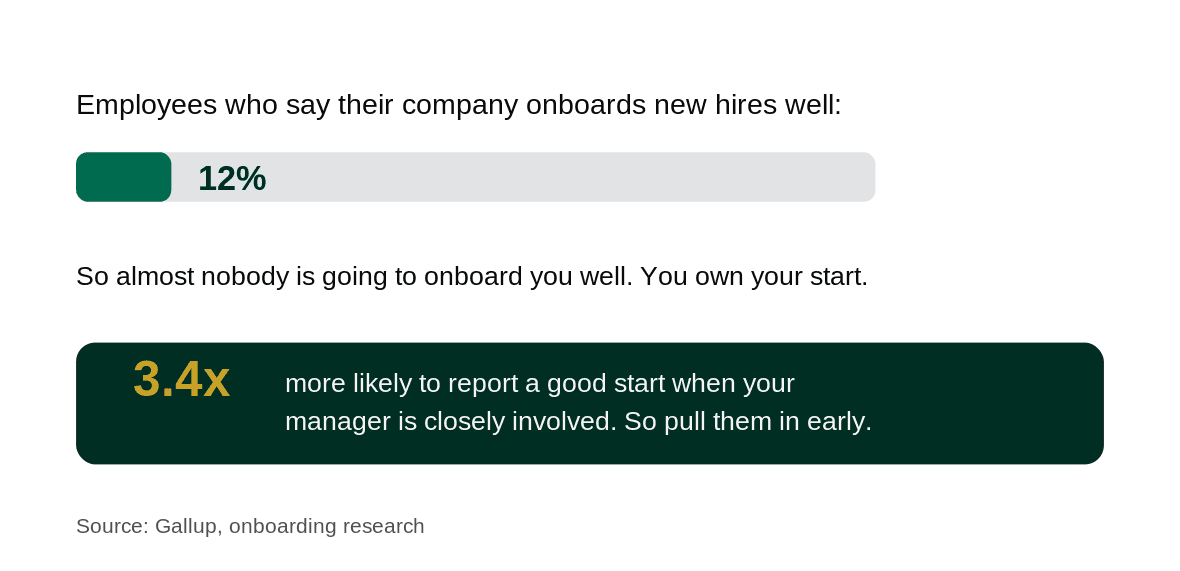
If you're stepping into your first Scrum Master role, make peace with this on day one: the structured, thoughtful onboarding you're quietly hoping for probably isn't coming. Gallup found that only 12 percent of employees strongly agree their company does a good job onboarding new people {Gallup}. So you have a choice. Wait to be shown, and look lost for three months. Or own your first 90 days on purpose.
The two ways new Scrum Masters blow it
There are two classic ways to start badly, and they're opposites.
The first is the Ghost. You're so worried about overstepping that you observe, and observe, and keep observing. Three months in, you've run the ceremonies exactly as you found them, changed nothing, and the team is quietly wondering what you're actually for. Caution curdled into invisibility.
The second is the Bulldozer. You've read a book, you've got opinions, and by Friday of week one you've reorganized the board, renamed the columns, and announced three improvements to people whose names you don't know yet. It feels decisive. It reads as arrogant, and it torches trust you haven't earned.
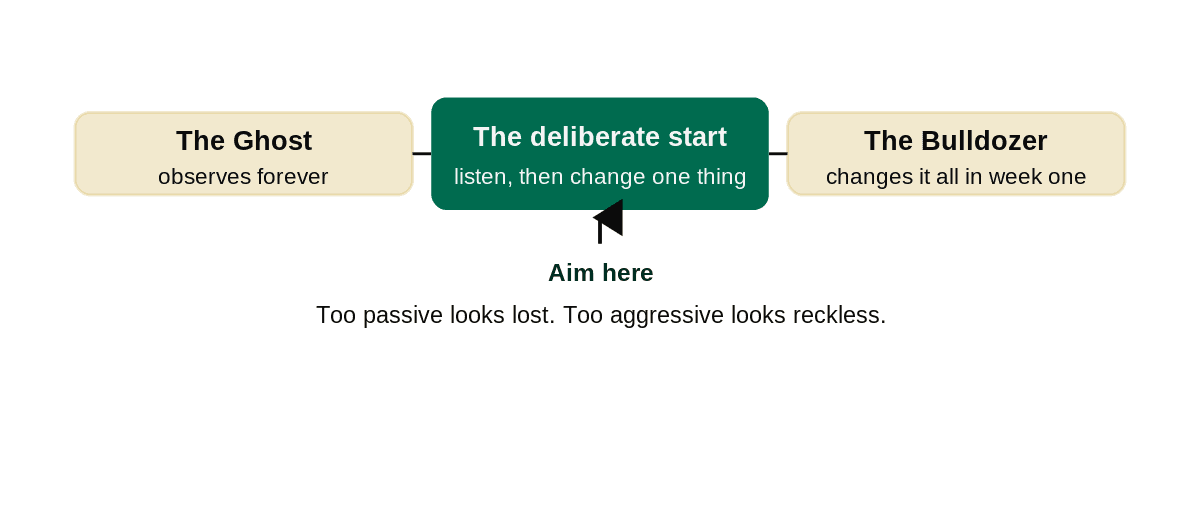
The job in your first 90 days is to live in that narrow middle. Deliberate, curious, useful, and patient enough to earn the right to change things before you change them. Here's how that splits across three months.
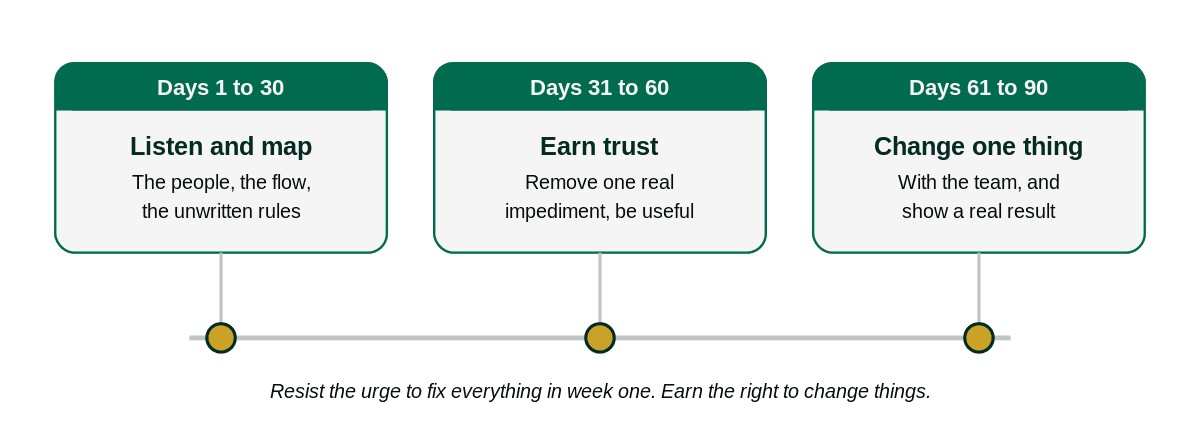
Days 1 to 30: learn the system and the people
Your only real job in the first month is to understand how things actually work, which is almost never how the org chart or the process doc says they do.
Map three things.
The flow: how work really moves from idea to done, and where it actually gets stuck, not where the board claims it does. The people: who holds influence, who's carrying tension, who quietly makes the decisions regardless of title. And the unwritten rules: what “done” really means here, which meetings matter, what's politically radioactive.
Run the ceremonies as you found them, and resist every urge to optimize. You're gathering evidence, and you can't diagnose a system you haven't watched under load. The most powerful sentence this month isn't “here's what I'd change.” It's “help me understand why it works this way.”
One concrete move: book short one-on-ones with every person on and around the team in your first two weeks. Not to impress them. To listen. Ask what's working, what's frustrating, and what they wish someone would finally fix. You'll learn more in those conversations than in a month of standups.
Write down what you hear, and sit on it. That list is gold. Two months later, when you propose a change, you'll be able to say “six of you told me the deploy process is the part that hurts most,” and it lands completely differently than an idea you walked in with. You're not just learning the system. You're collecting the team's own words to hand back to them when it counts.
Days 31 to 60: become useful, remove one real thing
Now you start earning trust, and trust is built on usefulness, not announcements.
Pick one real impediment, the kind the team has been grumbling about for months, and actually remove it. The flaky test environment. The approval that takes four days. The standup that runs forty minutes because nobody protects it. You don't need permission to make one concrete thing better, and one solved problem does more for your credibility than ten clever observations.
This is also where your manager matters more than you'd expect. Gallup found that when managers are closely involved in someone's start, that person is 3.4 times more likely to report a good onboarding {Gallup}. So don't wait passively to be managed. Pull them in. Tell them what you're seeing, ask what success looks like to them at 90 days, and make sure their picture and yours actually match. A surprising number of capable new hires struggle simply because they spent three months quietly solving for the wrong thing.
Days 61 to 90: change one thing that matters, with the team
By now you've earned the right to lead a change, so lead one. Singular.
Take the highest-leverage problem you found in month one and run a real experiment with the team, not at them. Maybe it's shrinking story size to fix a flow problem. Maybe it's a retro format that finally surfaces the conflict everyone has been avoiding. Frame it as “let's try this for two sprints and look at what happens,” not “we're doing this now.” Then measure something honest and show the team the result, good or bad.
Pick the measure before you start, and keep it honest. If you're shrinking stories to improve flow, watch cycle time and how often work gets blocked, not how busy everyone looks. A change that makes the board prettier but moves no real number is theater, and experienced people can spot it instantly. One true number that actually moved is worth more than a reorganized workflow nobody asked for.
That's how you want to exit your first 90 days. Not as the person who reorganized the board, but as the person who made one real thing measurably better, with the team's fingerprints all over it. That's the difference between activity and value, and it's exactly what a hiring manager means when they ask, in your next interview, “what did you actually change?”
The reframe to carry in
Here's the honest version. Feeling like you should be transforming everything by week two isn't ambition. It's anxiety, and it's the fastest way to burn the trust you'll need later. The new Scrum Masters who do best aren't the ones who change the most in 90 days. They're the ones who understand the most, earn the most trust, and then change the one thing that counts.
So if you're about to start, or you just have, write your own 90-day arc tonight. Learn, earn, change. One page. Nobody else is going to write it for you, and that isn't a problem to solve. It's your first real act as the person who runs the room.
Sources
Gallup. “Why the Onboarding Experience Is Key for Retention” (12% onboarding, manager involvement and the 3.4x figure). gallup.com

Subscribe to the Newsletter
Join our growing community and get alerted first on our every article.
*By subscribing, you agree to send your information to our Company who agrees to use it according to their Terms and conditions and Privacy Policy
About the author
I believe the strongest tool and flex each of us has is our belief. When we truly believe in something, we align our mindset, energy, and actions with the right effort and guidance. That is when achieving almost anything becomes possible. This is how I help mentees at OAKKTREEUNII move into Software and Project Management careers for better pay, better confidence, and better work-life balance.
Comments