Feedback that doesn’t put people on the defensive
ESTIMATED TIME
12
mins

Written by
Shikha Prasad
Published on
Words usually aren't the problem. The threat they set off is.
I once gave a piece of feedback I was genuinely proud of. It was fair. It was specific. I'd even used the tidy little formula I'd been taught. And I watched the person's face close like a door. Arms folded, jaw set, already assembling the case for why I was wrong. Nothing I had planned to say next was going to land, because they'd stopped listening somewhere around the word but.
For a long time I thought the secret to feedback was finding the perfect words. It isn't. People rarely get defensive because of the words you choose. They get defensive because of what those words set off inside them.
It isn't that they don't want it
Here's the part that surprised me most when I finally looked it up. People actually want the corrective feedback. When Zenger and Folkman surveyed thousands of workers for Harvard Business Review, 92% agreed that negative feedback, delivered well, is effective at improving performance, and more people said they wanted corrective feedback than wanted praise {Zenger and Folkman, HBR 2014}.
So the appetite is there. Defensiveness isn't a sign that someone doesn't care about getting better. It's a sign that something in the delivery tripped an alarm before the message could get through.
That reframe changed how I think about every awkward feedback moment I'd ever had. I used to read the crossed arms as proof the person was fragile, or stubborn, or not coachable. Almost always, that was wrong. They wanted to improve as much as I wanted them to. The wall went up faster than the wanting could catch up.
Why the door closes
That alarm is real, and it's far older than any of us. The neuroscientist David Rock describes how the brain handles social threats, a knock to your status, a sense of being treated unfairly, using the same machinery it uses for physical danger {Rock, SCARF, 2008}. Criticism, especially when it feels like a judgment of who you are rather than what you did, can fire that threat response in a fraction of a second.
And once it fires, the thinking part of the brain narrows. Stress chemistry rises, options shrink, and the person across from you isn't being difficult on purpose. They're under threat, and a threatened brain defends itself. It does not sit there calmly learning.
You've felt this from the other side. Think of the last time someone opened with so, we need to talk about your performance. Did you absorb their carefully chosen points? Or did your stomach drop and your mind start racing through every reason they might be wrong before they'd finished the first sentence? That's not weakness. That's a normal nervous system doing exactly what it evolved to do. The person you're about to give feedback to has the same one.
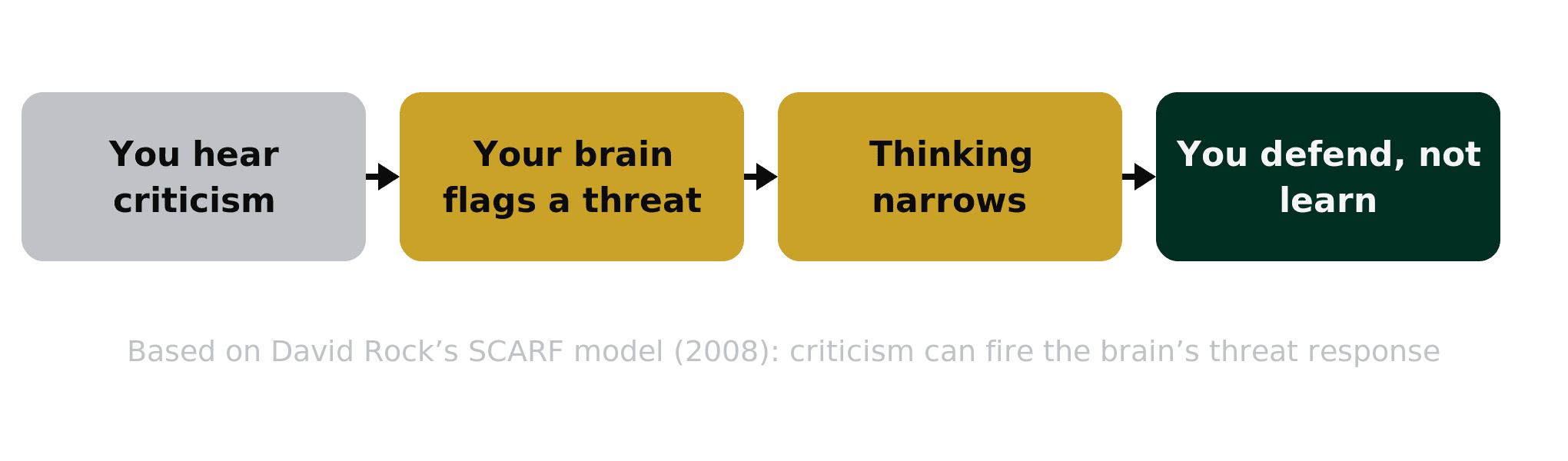
So the goal of good feedback was never to be gentler, or vaguer, or to bury the point under compliments. It's to keep the threat low enough that the person can stay in their thinking brain while you talk to them. Same honesty. Less alarm.
Four moves that keep the threat low
None of these is a trick or a softening. They're just ways of signalling I'm on your side clearly enough that the alarm doesn't go off.
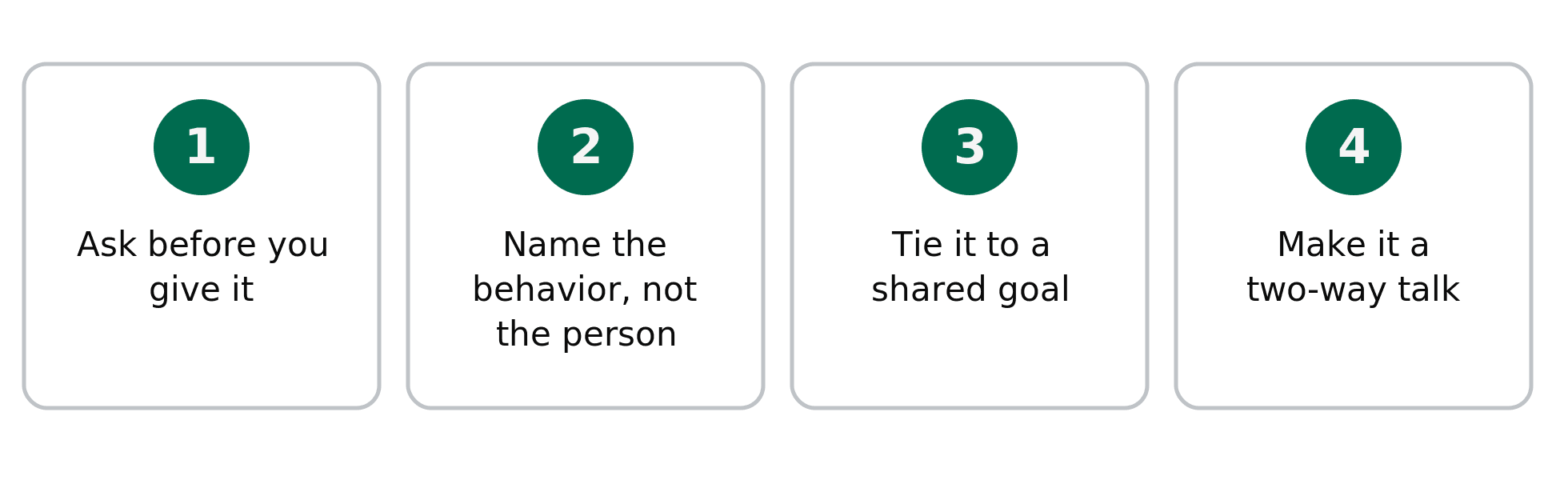
Ask before you give it. Can I share something I noticed? A tiny question, but it hands the person a sliver of control, and control is the opposite of threat. They almost always say yes, and now they're a participant, not a target.
Name the behavior, not the person. This is the big one. You're careless attacks who they are, and there's nothing to do with that but defend. The last two PRs went out without tests is a fact about a thing that happened, and facts about things can be fixed.
Tie it to a shared goal. Not this annoys me, but we both want this release to hold up. Now you're standing next to them looking at the problem, instead of being the problem they're looking at.
Make it a two-way conversation. End with a real question, not a verdict. What's getting in the way? You might learn the tests are painfully slow, or the deadline was never realistic, and your feedback was aimed at the wrong thing.
Same message, two temperatures
Watch what happens to the exact same concern when you change only the framing.
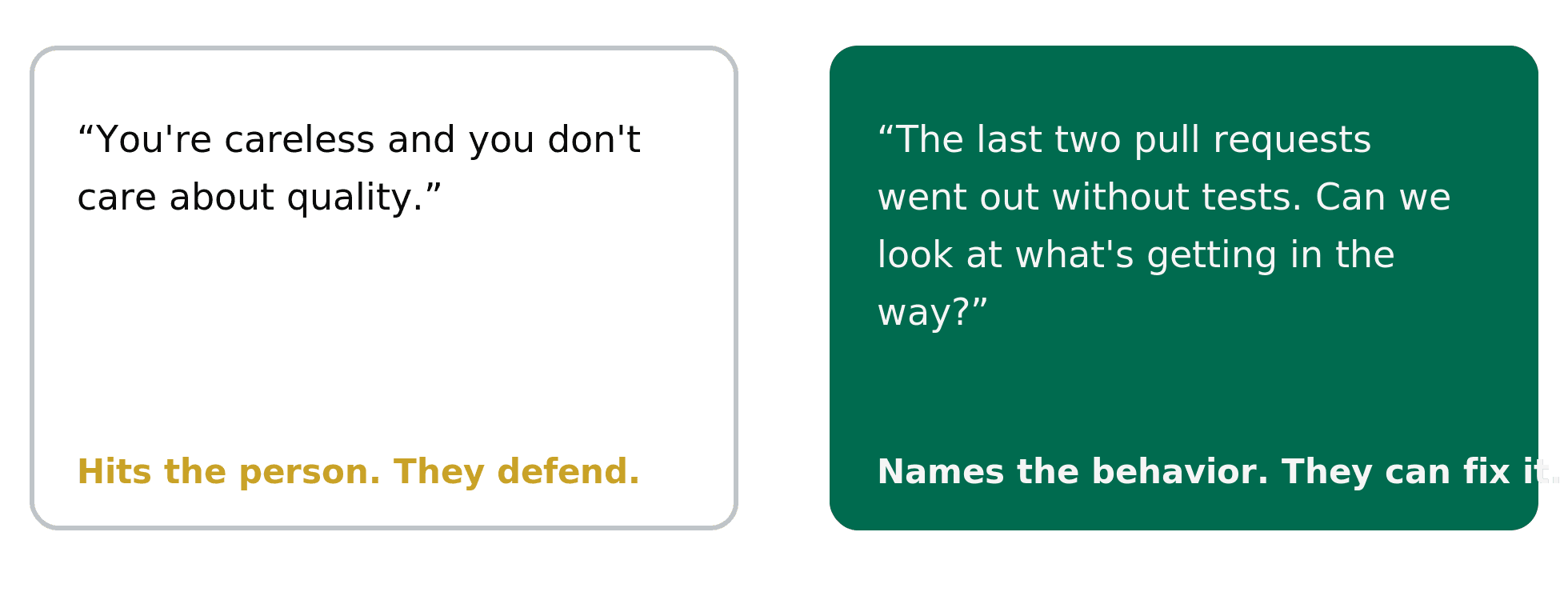
The left version is true and useless. It tells the person they're a bad person, which they'll reject on instinct, and it hands them nothing they can actually act on. The right version says the same thing, points at a specific behavior, and opens a door instead of starting a fight. Notice it isn't softer. Two pull requests going out without tests is not a gentle thing to say. It's just aimed at the work instead of at the person's worth.
This is also why the feedback sandwich, praise, criticism, praise, so often falls flat. People can feel the bread being used to smuggle in the filling, and the threat response fires anyway, plus now they don't trust the praise either. You don't need to disguise the hard part. You need to aim it somewhere the person can do something about.
Why this is the whole job of coaching
There's a reason this matters more for us than for almost anyone. A Scrum Master or a delivery lead usually has no authority to force a change. What we have is influence, and influence runs entirely on whether people stay open to us. Every time feedback lands as an attack, you spend a little trust you can't easily earn back. Every time it lands as help, you build the kind of relationship where people come to you before something breaks, instead of after.
And the people who are genuinely good at this aren't the ones who avoid hard truths to keep the peace. They're the ones who can say the hard truth in a way the other person can actually hear and use. That's a rarer and more valuable skill than simply being right, and it's the one that makes someone the coach a team actually wants to have around.
It shows up in interviews, too, if you're trying to get into one of these roles. Anyone can say they give direct feedback. The candidate who stands out is the one who can explain how they keep it from landing as an attack, who talks about asking permission, naming behaviors, leaving room for the other person's side. That answer tells a hiring manager you understand the actual mechanics of influence, not just the slogan that feedback is a gift. Most people only have the slogan.
So the next time you've got feedback that really matters, slow down before you reach for the perfect phrasing. Ask first. Aim at the behavior, not the person. Stand beside them, not across from them. Leave a real opening for their side of the story.
The point was never to soften the message until it disappeared. It was to lower the threat just enough that the message gets through the door instead of bouncing off it. Get that right, and you'll watch the same honesty that used to make people flinch start to be the thing they thank you for.
And if it doesn't land perfectly the first time, that's fine. You're not aiming for a flawless script. You're aiming to be the kind of person whose feedback feels safe to receive, and that reputation is built one careful conversation at a time.
Sources
Zenger, Jack, and Joseph Folkman. "Your Employees Want the Negative Feedback You Hate to Give." Harvard Business Review, 2014 (92% say negative feedback, delivered appropriately, improves performance).
Rock, David. "SCARF: A Brain-Based Model for Collaborating With and Influencing Others." NeuroLeadership Journal, 2008 (social threats fire the brain's threat response).

Subscribe to the Newsletter
Join our growing community and get alerted first on our every article.
*By subscribing, you agree to send your information to our Company who agrees to use it according to their Terms and conditions and Privacy Policy
About the author
I believe the strongest tool and flex each of us has is our belief. When we truly believe in something, we align our mindset, energy, and actions with the right effort and guidance. That is when achieving almost anything becomes possible. This is how I help mentees at OAKKTREEUNII move into Software and Project Management careers for better pay, better confidence, and better work-life balance.
Comments