The cold email that gets you past ’no local experience’
ESTIMATED TIME
6
mins

Written by
Shikha Prasad
Published on
A four-line note that turns a wall into a conversation, written by someone who has sent the bad version and the good one.
A woman I'll call Noor sent me her tracker last spring. Seventy applications. Two replies, both auto-rejections. She'd done everything the advice told her to. Tailored the resume, matched the keywords, applied within the hour. And every door had the same little sign on it. No local experience.
She wasn't under-qualified. She'd run delivery for a bank in another country for six years. The problem wasn't her. It was the door she kept knocking on. She was using the one route that's built to filter people like her out, and then taking the rejection personally.
So we stopped using that door. We wrote twelve emails instead of seventy applications. Three of them turned into calls. One of those turned into a contract. This post is the method we used, and the actual template, so you can do the same thing without sending a single line you'd be ashamed to read back.
Why the portal is the wrong door for you
Here's what no one tells the newcomer. The online application is designed to reduce a flood of people to a short list, fast. It does that with filters. And the easiest, laziest filter in the world is the phrase you keep hitting: local experience, or in Canada, Canadian experience.
It isn't really about geography. A standup is a standup in Toronto or Lahore. What the filter is nervously asking is, can this person work the way our teams work, and does anyone here vouch for them? The portal can't answer that, so it just screens you out and moves on.
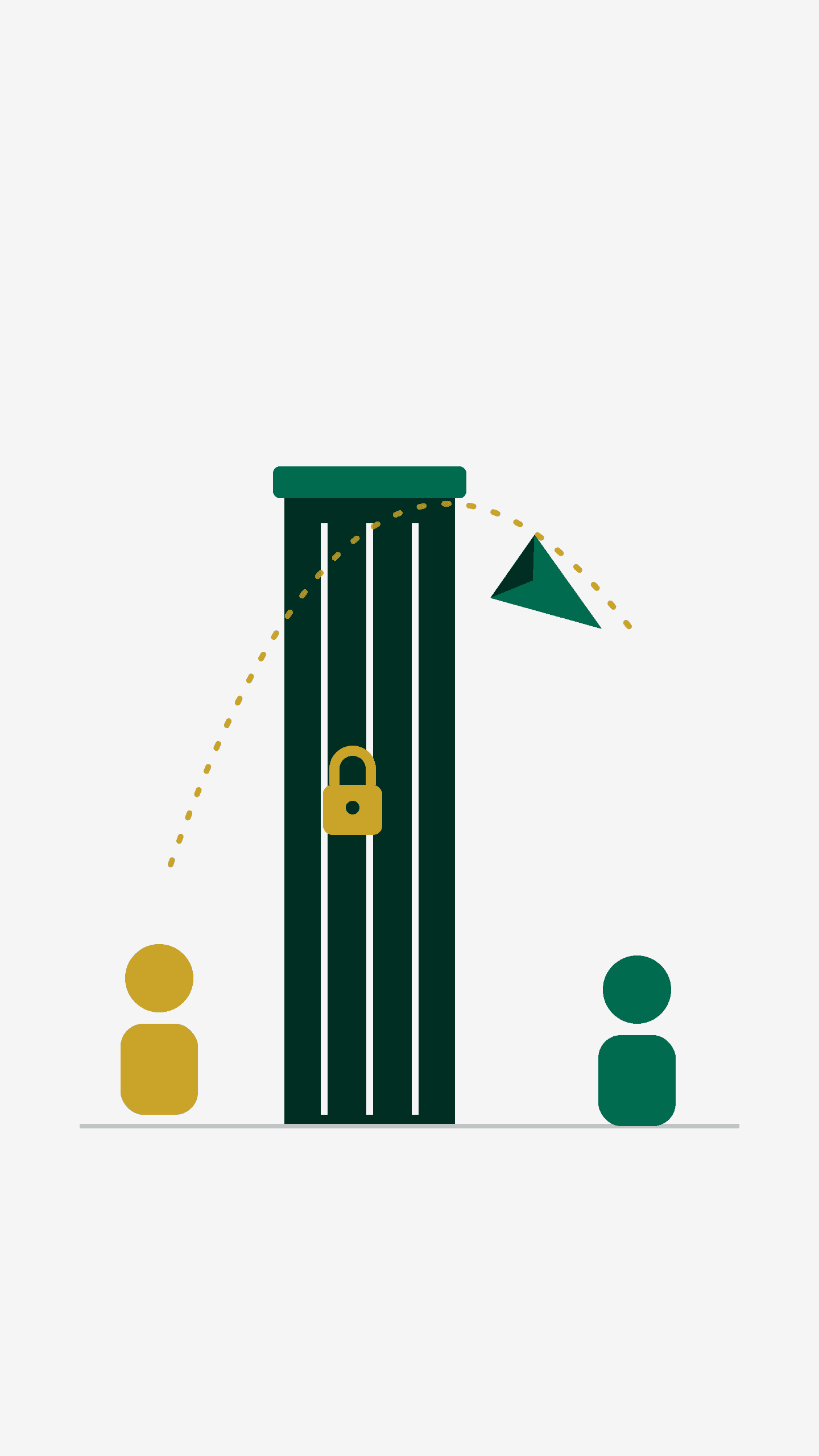
There's a second door, and it's been there the whole time. The recruiter who searches LinkedIn at 9pm. The hiring manager who reads a short note because it mentioned the exact thing keeping her up at night. That door doesn't run you through a filter. It puts you in front of a person. And a person can be persuaded in a way a filter never can.
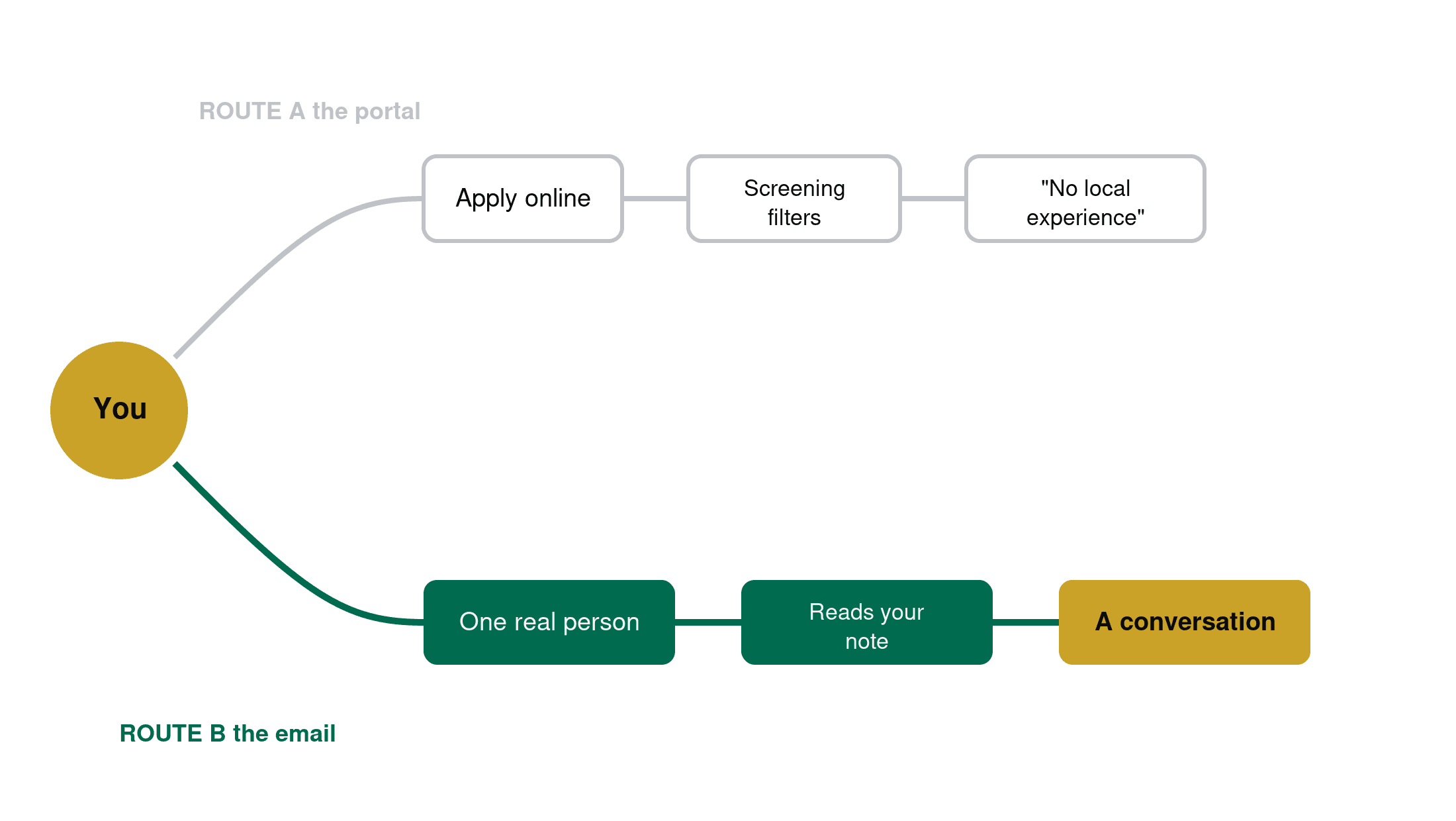
Same destination, two completely different odds. The portal sorts you by a field you can't fill. The email lets you walk around the filter and hand your case straight to someone who can decide.
The email is your work sample
This is the reframe that changes everything, so sit with it for a second.
You don't have local delivery experience yet. Fine. But a clear, specific, well-judged email is a sample of how you'd communicate on the job. When a hiring manager reads a note that names her actual problem, gives her something useful, and asks for a small, reasonable thing, she's watching you do delivery work. Reading a room. Managing a stakeholder. Being concise. That's the whole job.
A good cold email isn't you asking for a chance. It's you quietly proving you'd be good at the thing, before anyone agreed to hire you for it.
Most cold emails fail because the sender forgets this and writes a tiny begging letter. Mine, the first time, was a begging letter. I learned the slow way that nobody answers those. The note that works does the opposite. It arrives like a small gift, not a small request.
The four lines that do the work
Keep the whole thing under a hundred words. A busy person reads it on her phone between meetings. If she has to scroll, you've already lost. Four lines, each doing one job.
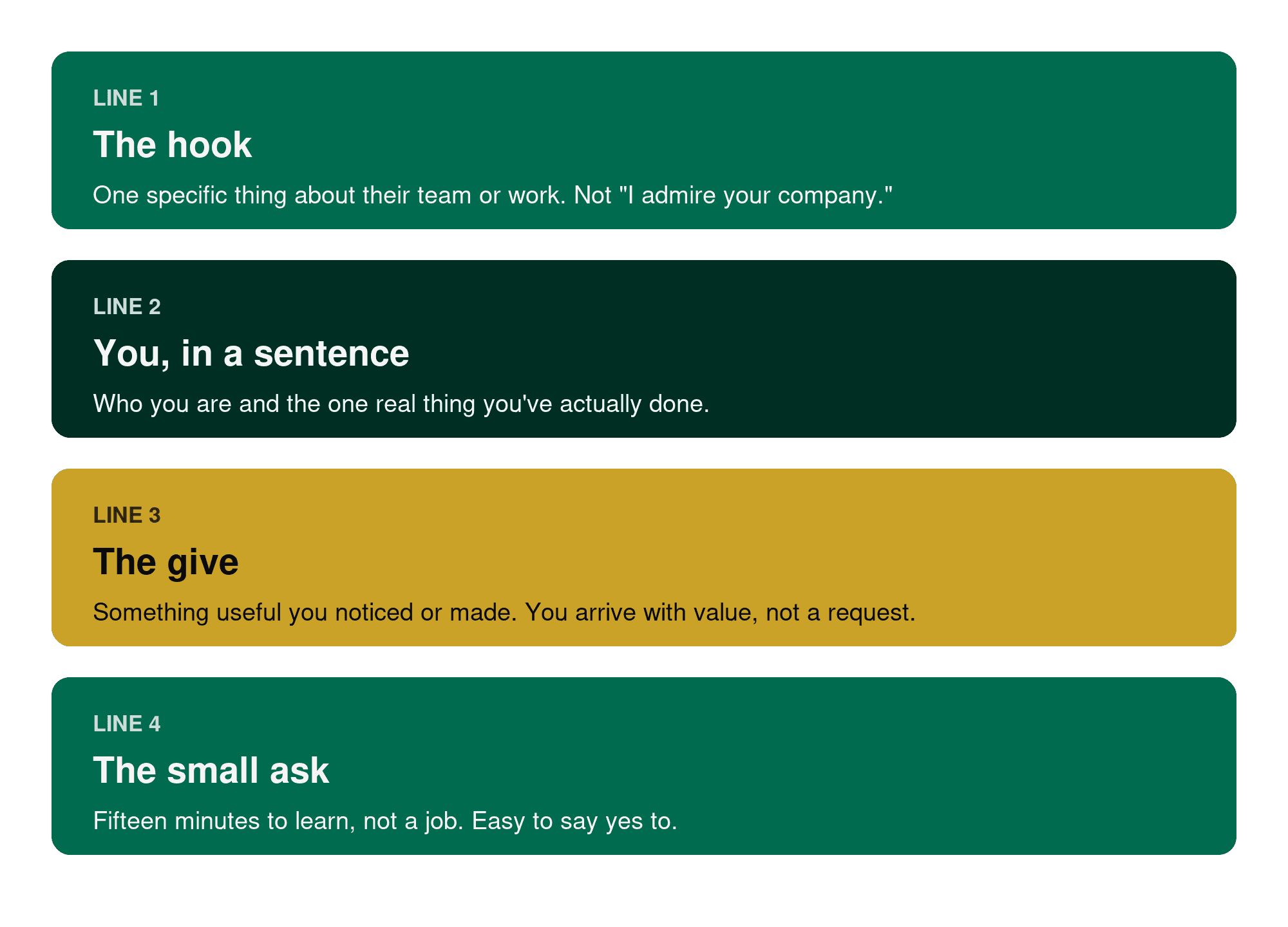
Line one: the hook that proves you looked
Open with one specific, true thing about their team or their work. Something you could only know if you'd actually paid attention. Not "I admire your company's mission," which tells her nothing except that you found the homepage. Try "I saw your team moved to two-week sprints last quarter and you're hiring two more delivery people," which tells her you did the work.
Line two: who you are, honestly, in one breath
One sentence. Who you are and the one real thing you've genuinely done. "I'm a Scrum Master who ran delivery for a 9-person team rolling out a food-bank intake system this year." Notice what that is and isn't. It's true. It's specific. It doesn't claim a Canadian title you don't have, and it doesn't apologize for the title you do have. You translate the experience into delivery language. You never shrink it or invent it.
Line three: the give
This is the line almost everyone skips, and it's the one that gets you answered. Bring something useful. A short writeup of how you solved a problem her team is clearly facing. A two-line observation about her process. A resource. "I hit the same refinement wall on that rollout and wrote up how we fixed it, happy to send it over." You're not arriving with your hand out. You're arriving with something in it.
Line four: the small ask
Ask for the smallest possible yes. Not a job. Not even an interview. Fifteen minutes to learn how she handles something. "Could I steal 15 minutes to hear how your team handles refinement?" A job is a huge ask from a stranger. Fifteen minutes of talking about her own work is almost rude to refuse.
The same person, two emails
Here's what it looks like side by side. Left is the version Noor sent for the first six weeks. Right is the one we wrote together. The person didn't change. The note did.
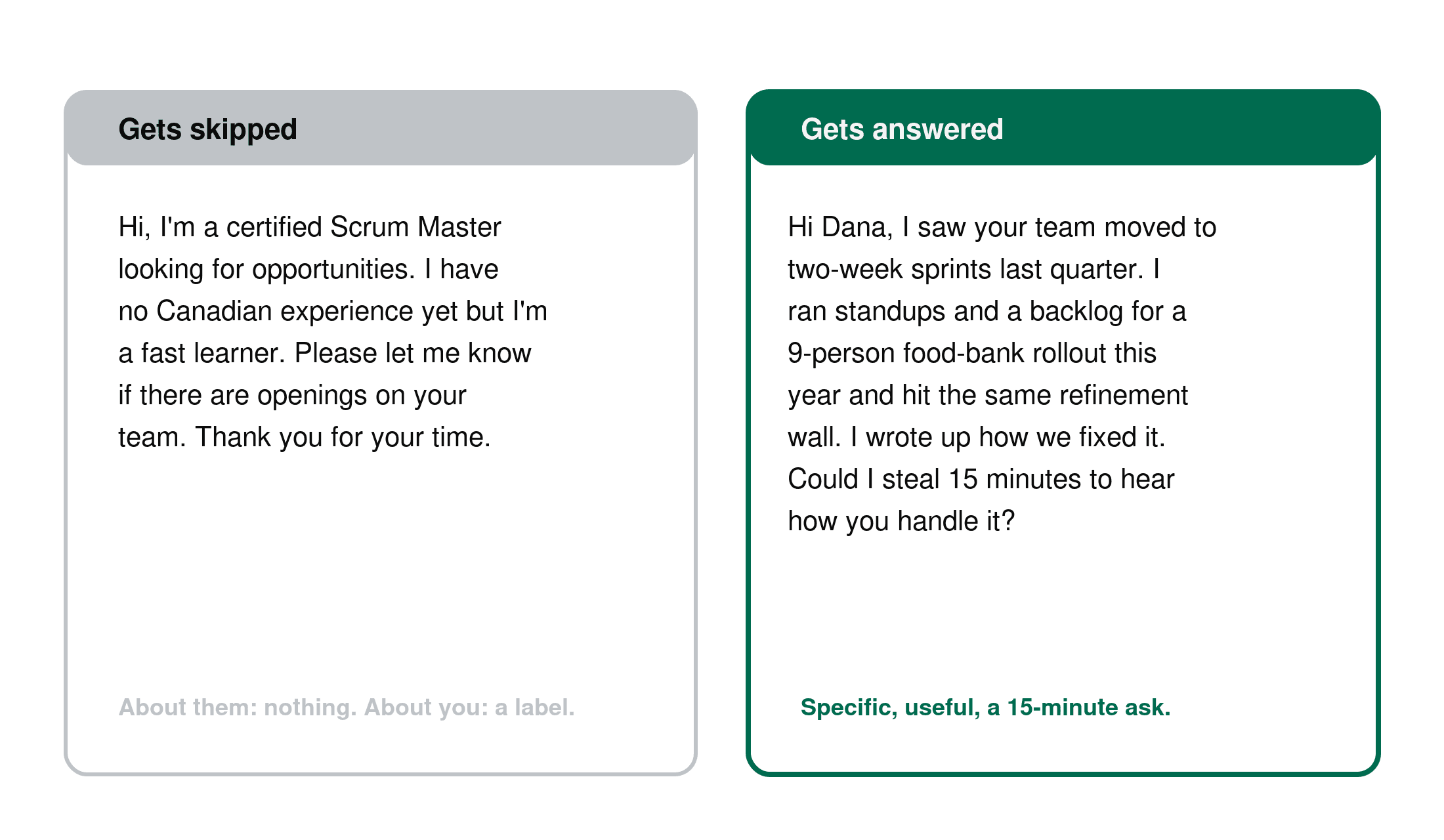
Read the left one as the hiring manager. It's about the sender, and the only fact in it is a label and a gap. "No Canadian experience" is the first thing it volunteers, which is like leading a sales pitch with the product's flaw. There's nothing to reply to.
Now read the right one. It opens on her, not on you. It carries a real, specific piece of delivery history. It offers something. And the ask is so small that saying yes costs her nothing. One of these gets archived. The other gets a reply that starts with "Sure, Thursday work?"
Pick the twelve, not the seventy
You don't send this to a hundred people. The whole point is that it's specific, and specific doesn't scale. So you choose well.
Make a short list of twelve people, not twelve companies. Real humans you can name. The delivery lead at a company you'd actually want to work for. A Scrum Master two years ahead of you whose path you could follow. A recruiter who keeps posting the roles you want. You're not blasting a market. You're starting twelve small relationships.
Find them on LinkedIn by title, not by open req. The person matters more than the posting.
Read their recent activity before you write a word. Your hook lives in there.
Write each email from scratch. The moment two of them could be swapped, both are dead.
Track replies, not sends. Twelve thoughtful notes will out-perform seventy applications, and it isn't close.
This is slower per email. It's far faster to the outcome. You're trading volume for the one thing the portal strips out: a human reading your actual words.
What one yes actually buys you
Here's the part people miss when they think a coffee chat is just a coffee chat. The first fifteen minutes don't get you the job. They get you the things that get you the job.
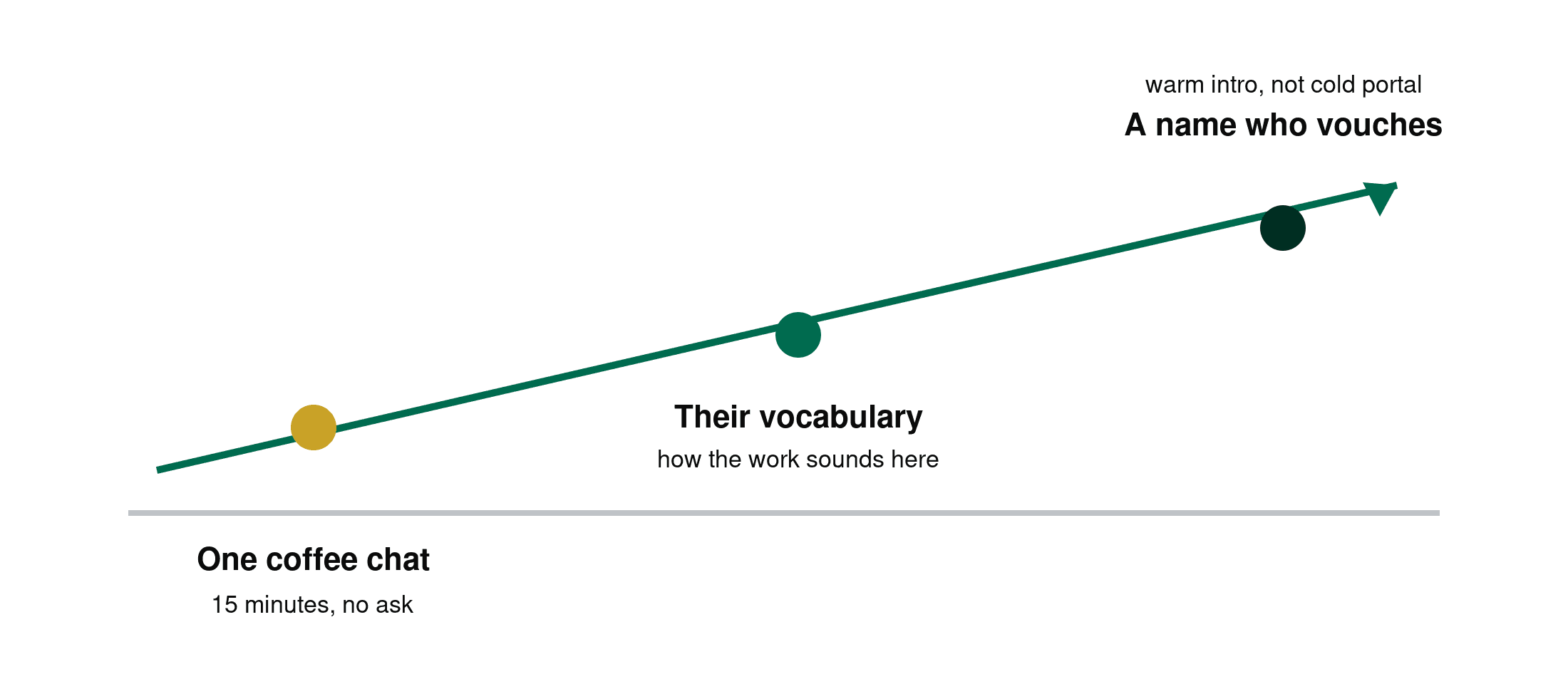
You walk out with their vocabulary. How delivery actually sounds at companies here, which words land and which mark you as new. You walk out with a clearer picture of what local teams really worry about, which sharpens your next eleven emails. And often, if the conversation went well, you walk out with "let me introduce you to someone." That warm introduction is the thing the portal can never give you. It's the exact opposite of the cold filter that kept rejecting Noor.
That's how a wall turns into a door. Not in one heroic email. In a handful of small, genuine conversations that each leave you a little more inside than you were before.
Don't fake the experience. Go make a small one.
One honest caution, because I won't pretend the email is magic. If you have no real delivery reps at all, the give in line three rings hollow, and a sharp person will feel it. The fix is not to invent a story. It's to go build a small, real one this month so you have something true to point at.
Run a real practice project with a real backlog and real standups. Volunteer to facilitate a nonprofit team's planning. Lead one recurring meeting at your current job and run it like a delivery pro. Any of these gives you a genuine "I did this, here's what I noticed, here's what changed" to drop into line two and line three. Then the email isn't a clever trick. It's a true person describing true work, just to someone who hasn't met them yet.
You don't write your way past the experience gap. You build a small, real version of the experience, then you write the note that gets the right person to look.
Noor had the experience the whole time. Six years of it. What she'd been missing wasn't a qualification. It was a door that let a human read her words before a filter threw them out. The cold email is that door. Write four honest lines, send twelve of them, and stop letting a dropdown menu decide what your career is worth.
Subscribe to the Newsletter
Join our growing community and get alerted first on our every article.
*By subscribing, you agree to send your information to our Company who agrees to use it according to their Terms and conditions and Privacy Policy
About the author
I believe the strongest tool and flex each of us has is our belief. When we truly believe in something, we align our mindset, energy, and actions with the right effort and guidance. That is when achieving almost anything becomes possible. This is how I help mentees at OAKKTREEUNII move into Software and Project Management careers for better pay, better confidence, and better work-life balance.
Comments