The AI teammate is coming to your standup. Now what?
ESTIMATED TIME
7
mins

Written by
Rajveer Prasad
Published on
It already writes the code and summarizes the meeting. The good news is buried in what it still cannot do.
Let's start with the fear, because you already have it. An AI tool now writes a chunk of your team's code, drafts the release notes, and can summarize your standup before you've finished running it. So the quiet question in every newer Scrum Master's head is simple. If the machine runs the ceremony, what exactly is left for me?
Here's the blunt version. The parts of your job a model can do were never the parts that paid you. You just got used to hiding behind them.
What the machine actually took
Be honest about what AI is good at on a delivery team. It's good at the typing. Summaries, boilerplate, first-draft code, status roll-ups, meeting notes, ticket descriptions. The mechanical middle of the work.
And teams have noticed. In the 2024 Stack Overflow survey, 76 percent of developers said they use or plan to use AI tools, and 62 percent already do {Stack Overflow Developer Survey, 2024}. Your developers are not waiting for a memo. The AI teammate is already in the room, in the seat nobody assigned.
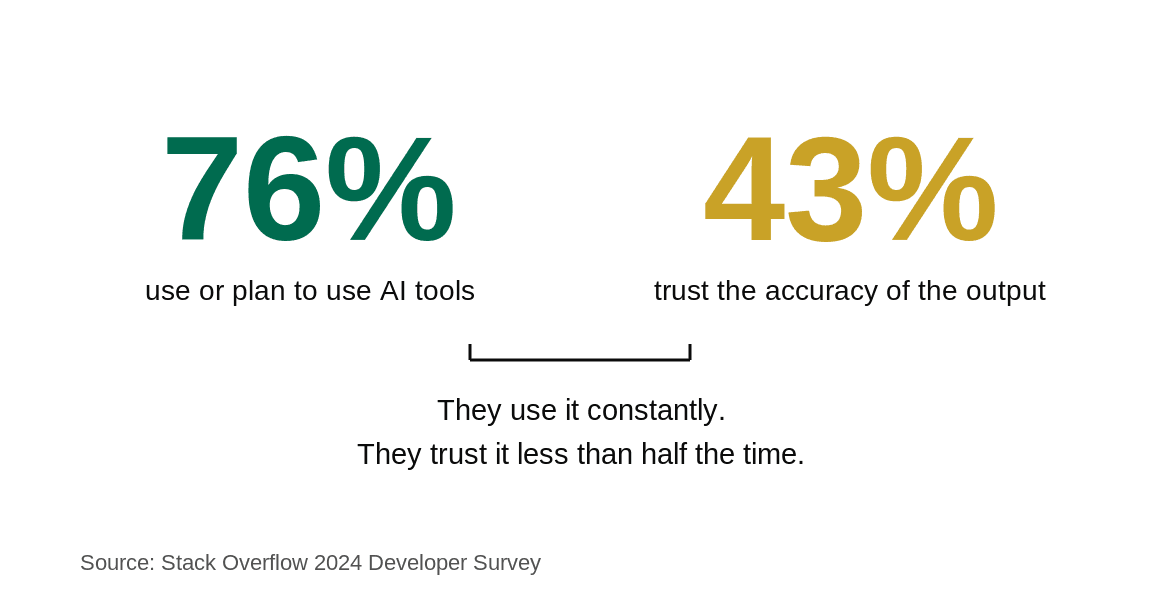
But look at the second number from that same survey. Only 43 percent of developers say they trust the accuracy of what these tools produce {Stack Overflow Developer Survey, 2024}. They reach for it constantly and trust it less than half the time. Sit with that for a second, because it tells you who is still holding the judgment. It isn't the model.
The gap the data quietly exposes
Now the finding that should reframe your whole role.
Google's 2024 DORA research looked at what happens to delivery as teams take on AI. Individuals got faster and happier. But at the system level, every 25 percent jump in AI adoption was associated with an estimated 1.5 percent drop in delivery throughput and a 7.2 percent drop in delivery stability {DORA, 2024}. Faster typing, shakier delivery.
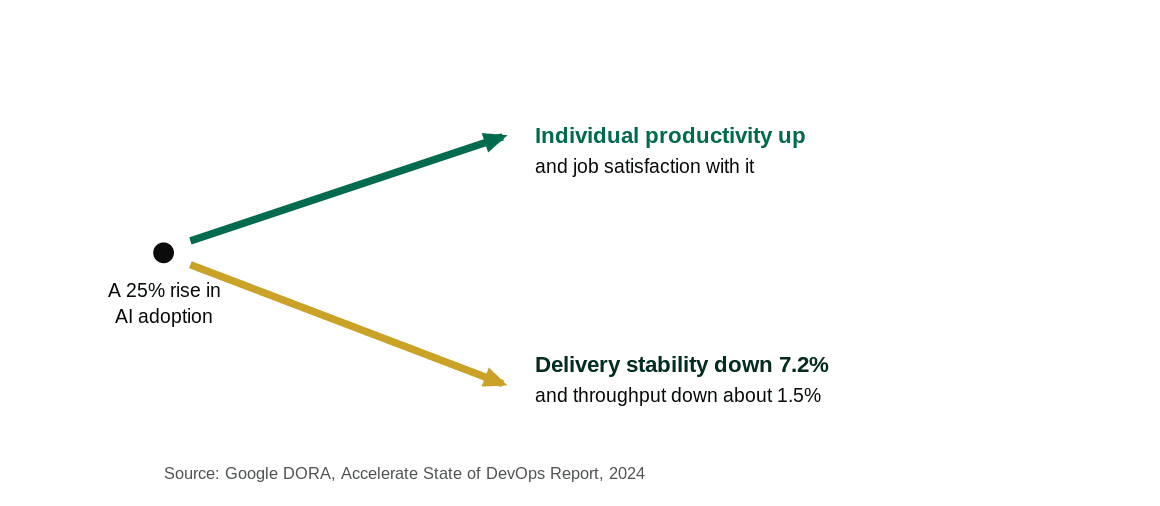
That's not an argument against AI, and DORA doesn't make one. Their read is that the fundamentals slipped: bigger change sets, thinner testing, more code than anyone carefully reviewed. Which is about the most quietly damning sentence in the report, because every one of those is a Scrum Master problem. Batch size. Flow. Quality gates. The discipline that stops speed from turning into a mess.
You can watch it happen on a real team. A developer accepts a large AI-generated change, it passes the happy-path tests, it merges late on Friday, and Monday morning the on-call engineer is getting paged because an edge case nobody actually read fell over in production. Now multiply that across a team that ships faster than it reviews. That is the DORA number, in one story.
The tool made the team faster at producing. It did nothing for the team's judgment about what to produce, in what size, and whether it actually works. That gap is your job description now.
Where your value moves
Think of it as your value moving up a rung. You stop being the person who collects the status, because the tool collects the status. You become the person who reads it.
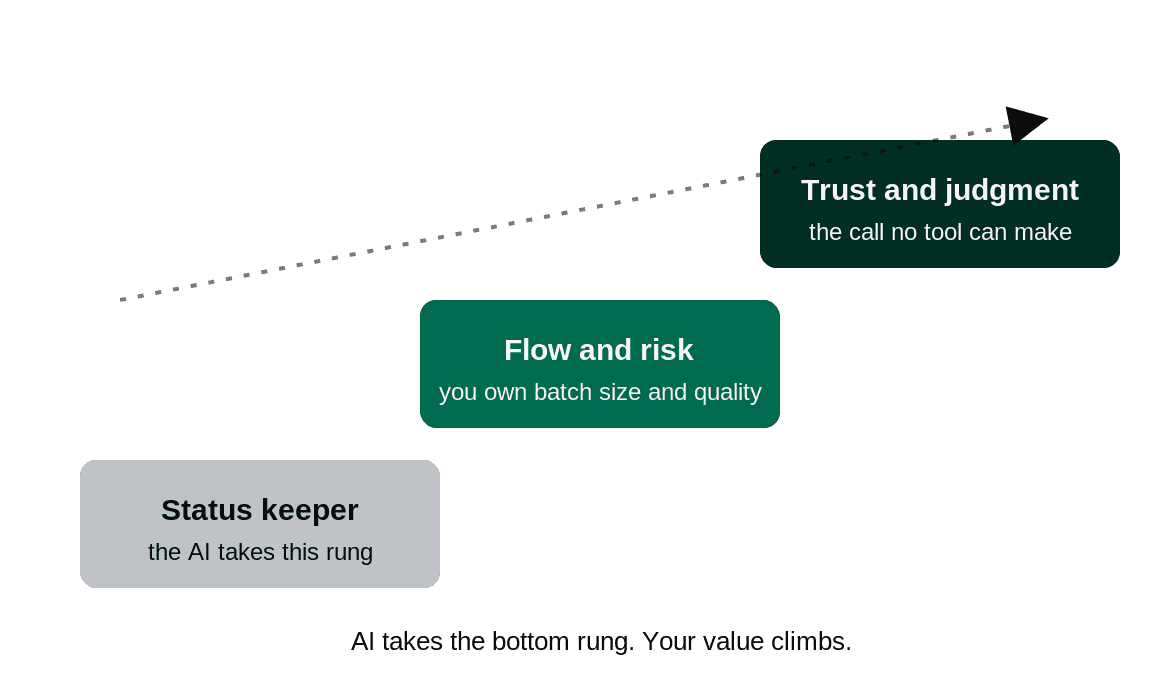
Three moves, concretely.
Stop narrating the board. Start interrogating it.
The AI can tell you a ticket moved. It can't tell you the same task has quietly been reopened three sprints running because two engineers don't trust each other's code. You can. One is data entry. The other is the job.
Stop chasing updates. Start protecting flow.
If AI is helping the team ship bigger, messier batches, the most valuable thing you can do is shrink them. Smaller stories, tighter work-in-progress limits, a definition of done with teeth. Unglamorous, and exactly what the DORA numbers are begging for.
Stop summarizing. Start surfacing.
A model summarizes what was said. Your job is what wasn't. The blocker nobody named. The “no concerns” that is obviously a concern. The silence right after a risky estimate. No transcript tool catches that, because it isn't in the transcript.
Picture a real standup. The AI notes will say: three tickets moved, one blocker raised, sprint on track. What they won't say is that the senior engineer went quiet the moment the new hire described their approach, or that “on track” landed in the same flat tone as last sprint, the one right before it wasn't. You were in the room for the tone. That read is the one that saves the sprint, and it's exactly the one the summary can't make.
The thing it cannot fake
Here's the part no tool is coming for. Trust is a human transaction. When a developer admits they're stuck, when a stakeholder hears bad news early and doesn't detonate, when a team gives the real status instead of the safe one, that happens because a person built the conditions for it. A summary bot does not build psychological safety. It can't even tell that it's missing.
And the trust gap cuts both ways. Developers believe the AI's output less than half the time, so someone has to own the call on when to ship the machine-written code and when to send it back. That's judgment under uncertainty, with real consequences attached. It's the most senior thing on a delivery team, and it has your name on it.
Fair pushback: won't the models get better at the human stuff too? Probably, at the surface of it. A tool will get sharper at flagging a stalled ticket or drafting a kinder message. But the moment that actually matters is not the message. It's a person deciding to tell you the truth because they've concluded you're safe to tell. That's a bet someone makes about you, not about your tooling, and no vendor ships it in the next release.
What to do on Monday
If you want to be the Scrum Master who gets more valuable as the tools get better, not less, do three things this sprint.
Hand the AI one piece of your busywork on purpose. The status roll-up, the notes. Free the time deliberately, do not just feel guilty about the tool.
Spend that freed time on one human read. Watch where flow actually breaks. Find the conversation that isn't happening, and start it.
Put one number in front of the team that the tool can't move for you. Batch size, cycle time, reopened tickets. Then coach the team to shift it.
Do that, and you stop competing with the machine on the work it's good at. You start owning the work it exposes. In an interview, that's the difference between “I run the ceremonies” and “I keep delivery stable while the team ships faster than ever.” One of those sounds replaceable. The other sounds like the job.
The tools will keep getting better at the typing. Your move isn't to type faster. It's to get sharper at the things that only matter once the typing stops being the hard part: flow, risk, and trust.
Sources
Stack Overflow. “2024 Developer Survey: AI.” 2024. survey.stackoverflow.co/2024/ai
Google DORA. “Accelerate State of DevOps Report 2024.” 2024. dora.dev/research/2024/dora-report

Subscribe to the Newsletter
Join our growing community and get alerted first on our every article.
*By subscribing, you agree to send your information to our Company who agrees to use it according to their Terms and conditions and Privacy Policy
About the author
With 20 years guiding high-stakes Agile transformations, I turn theory into action at Oaktreeuni—mentoring aspiring Scrum Masters to think critically, adapt fast, and lead beyond frameworks. The payoff? You step into a high-paying Scrum Master or Agile PM role already equipped to excel.
Comments