Agile was built for a room. Your team isn’t in one.
ESTIMATED TIME
15
mins

Written by
Shikha Prasad
Published on
The ceremonies still work. The free things the room used to do? Those you now have to build on purpose.
My first fully remote team confused me for a solid month. I ran the same ceremonies that had worked beautifully when we all sat together: the standups, the planning, the retros, all of it straight out of the book. And they went flat. Standup turned into a roll-call where everyone recited their tasks to a wall of muted squares. Blockers that someone would once have blurted out across a desk now sat quietly hidden for days.
The work was getting done, but the team didn't feel like a team. It took me a while to understand why, and it wasn't the people, and it wasn't the tools. It was that I'd moved the ceremonies online and quietly assumed everything around them would come too. It didn't.
If you're running a remote or hybrid team and something feels subtly off, this is probably it. Not a tooling gap you can fix with another app. Something quieter, and more fixable once you can see it clearly.
Agile was written for a room
Go back to the source and it's right there in black and white. One of the twelve principles behind the Agile Manifesto says the most efficient and effective method of conveying information to and within a team is face-to-face conversation {Agile Manifesto}. The whole framework was designed around a picture: a team in one space, a wall of cards everyone could see, conversations happening in the open air, someone overhearing a problem and leaning over to help with it.
That picture wasn't a nice-to-have. It was the operating assumption. And for years it held, because most teams really were in a room. The trouble is the room was quietly doing a great deal of the work, and the framework never had to name any of it, because it was simply always there.
The room was doing more than you realized
Think about everything a shared space handed you for free.
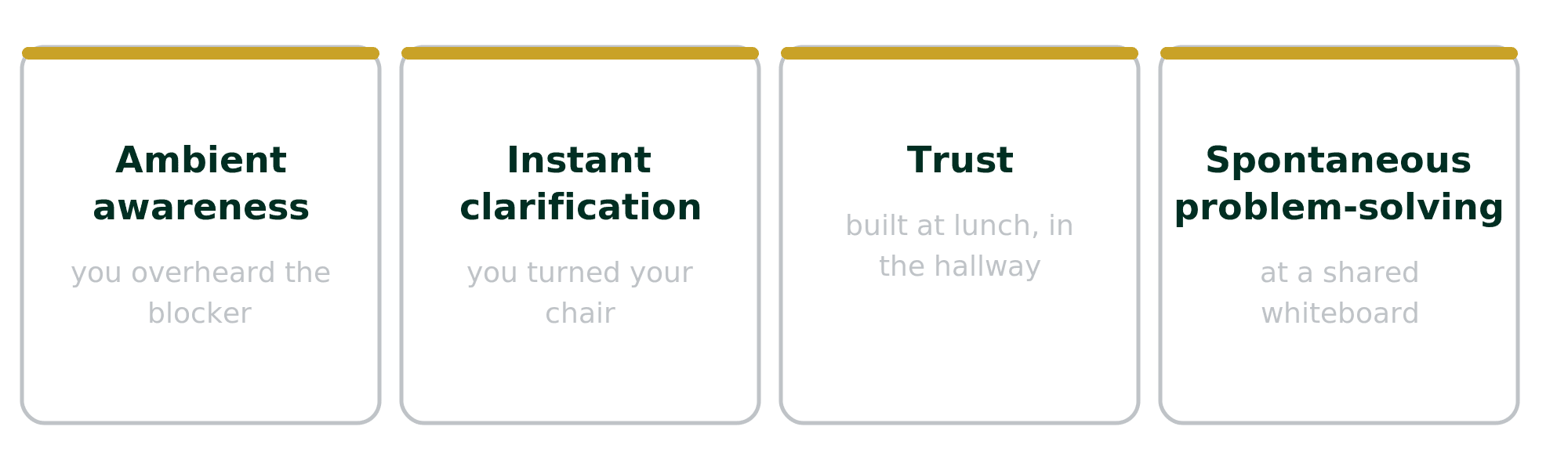
You knew what was going on without anyone reporting it, because you overheard it. That's ambient awareness. When you got stuck, you turned your chair and asked, and had an answer in ten seconds. That's instant clarification. Trust got built sideways, at lunch and in the corridor, not in any meeting on the calendar. And when something was genuinely hard, three people drifted to a whiteboard and solved it on the spot.
None of that was in the Scrum Guide. None of it was a ceremony you could schedule. It was the connective tissue the room provided whether you planned for it or not. And here's what nobody warns you about: when the room goes away, that tissue doesn't migrate online by itself. It just quietly vanishes, and you don't notice until the team feels strangely disconnected and you can't quite name why.
Think about the blocker that used to surface in seconds. In the room, a developer would mutter the API is down again and three people would turn around. Remote, that same developer has to decide it's worth opening a channel, typing it out, and interrupting people who look busy, so they often just keep wrestling with it quietly. The blocker didn't change. The cost of surfacing it did, and that small extra friction is enough to keep problems hidden for a day or two longer than they ever would have been across a desk.
And it really does vanish, the data says so
This isn't nostalgia talking. When Microsoft researchers studied more than sixty thousand of their own employees through the shift to remote work, they found the collaboration network became measurably more siloed and static. People spent about a quarter less of their time collaborating across groups, the bridges between different parts of the organization thinned out, and communication shifted from real-time to asynchronous {Yang et al., Nature Human Behaviour 2022}.
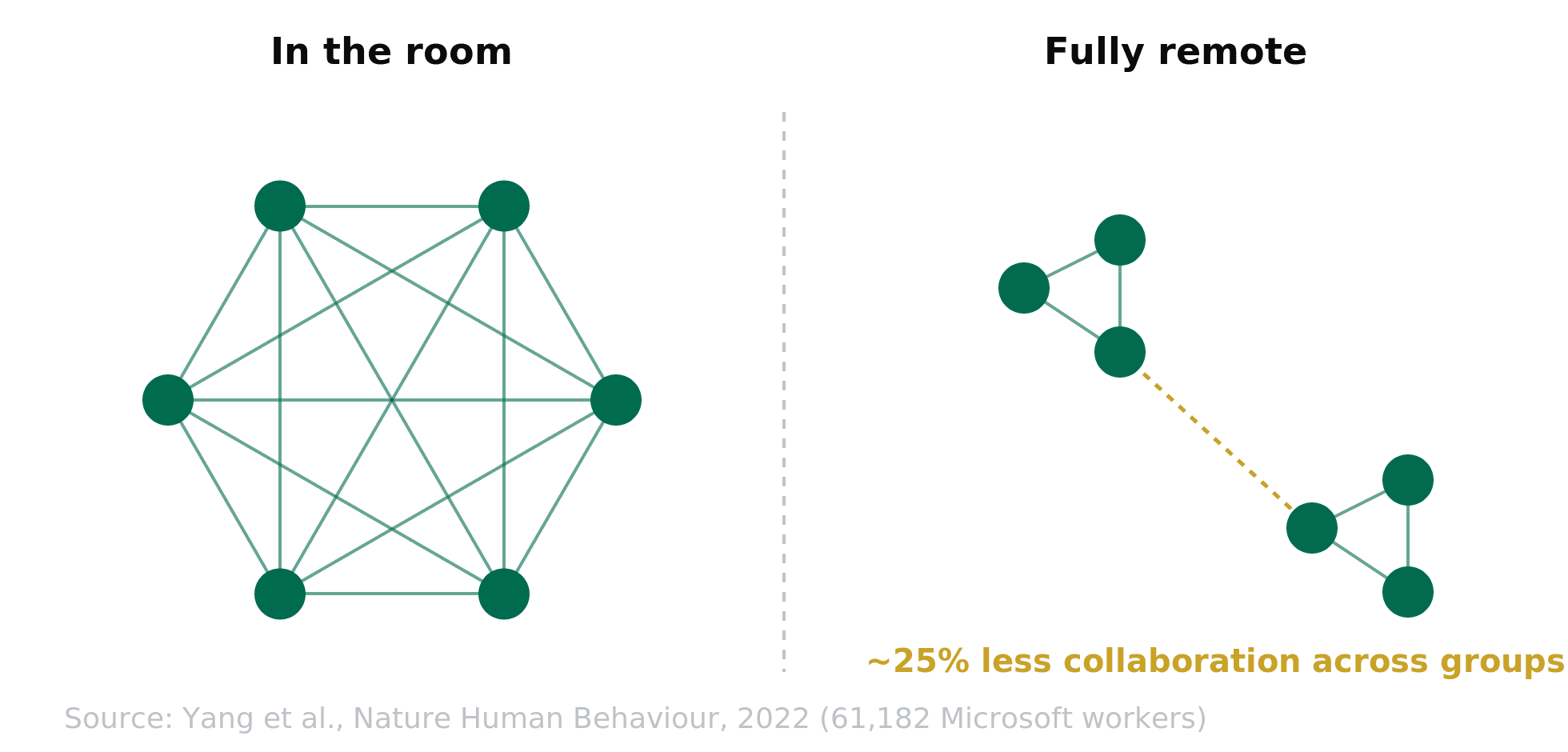
Read that as the room's connective tissue showing up in hard data as it frays. The weak ties, the chance encounters, the cross-team bridges, those are exactly what a shared space generated for free, and exactly what distance quietly erodes. The work inside each little cluster carries on fine. It's the connections between the clusters that go missing, and those are usually where the important, unexpected things used to happen.
Rebuild what the room gave you, on purpose
So here's the shift, and it is not about tools, and it's certainly not about dragging everyone back to the office. It's about noticing what the room used to provide and then deliberately engineering each piece of it back.
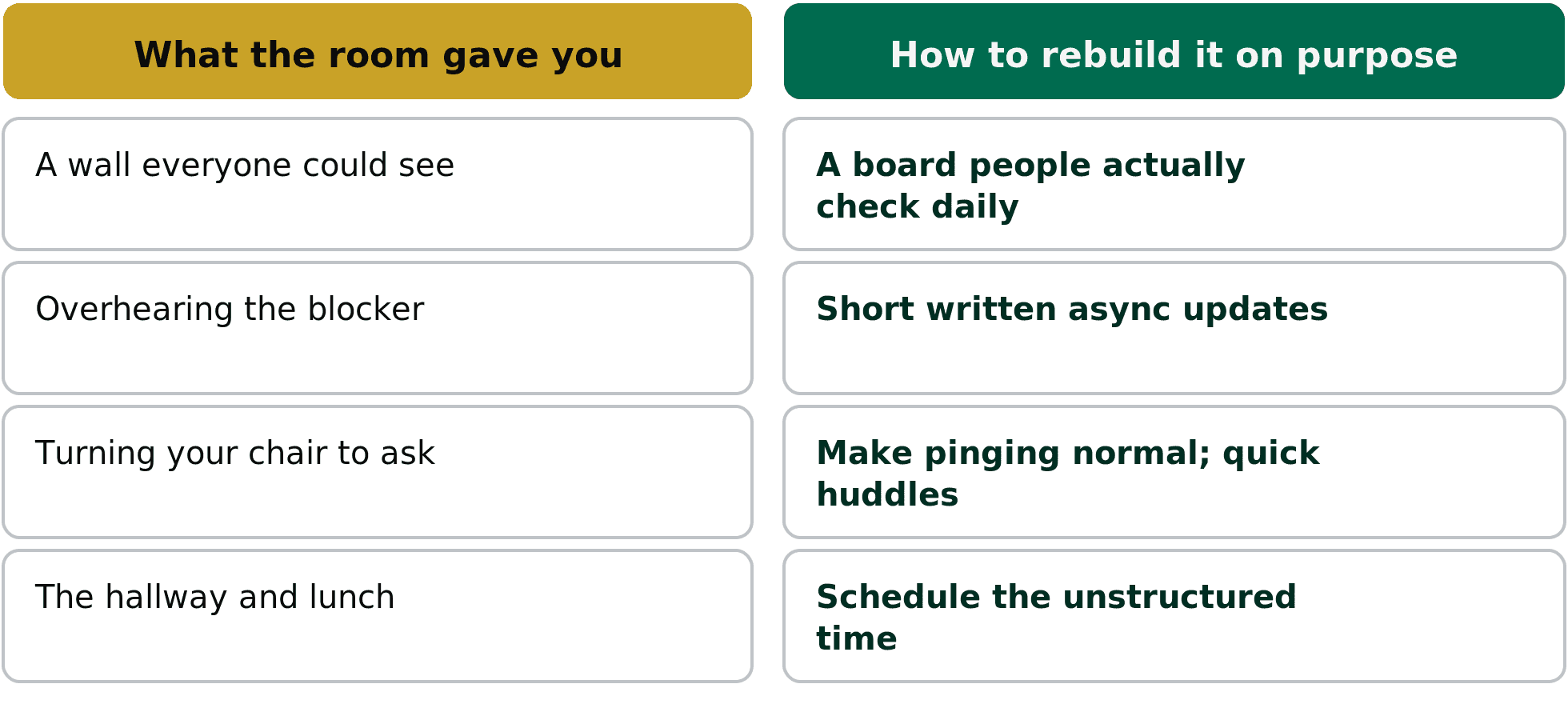
The wall of cards becomes a board people genuinely look at every day, not one that exists but nobody opens. Overhearing the blocker becomes a habit of short, written, scannable updates, so awareness happens on purpose instead of by luck. Turning your chair becomes an explicit team norm that pinging someone isn't just allowed, it's expected, backed by a quick huddle when text isn't enough. And the hallway, the hardest one to replace, becomes time you actually put on the calendar: deliberate unstructured space, pairing sessions, a few minutes of nothing-in-particular at the top of a call. You cannot leave connection to chance when there's no hallway for it to happen in.
Spend face-to-face on what only it can do
One more thing that Manifesto principle still gets right, even now. Face-to-face really is the richest way to communicate, so on the rare occasions you get it, synchronous time on a call or in person, don't waste it on status. Status is the cheapest thing in the world to handle asynchronously. Spend the expensive, high-bandwidth time on the things that actually need it: the conflict that's quietly brewing, the messy design decision with five opinions, the trust that only builds when people genuinely see each other. Default to async for information. Save sync for the human work that can't survive a text thread.
This is also the reframe that gets remote teams to stop resenting their meetings. Most meeting fatigue isn't from too much synchronous time, it's from spending the precious synchronous time on things that should have been a written update. Move the status to async and protect the live time for the genuinely human work, and people stop dreading the calendar, because every meeting that's left is one that earns being a meeting.
Name what you lost, then build it back
Agile wasn't wrong. It was written for a world where the room came included, and a lot of teams simply don't get the room anymore. The teams that thrive distributed aren't the ones with the fanciest tools or the strictest return-to-office rules. They're the ones who looked honestly at everything the room used to do quietly in the background, and then rebuilt it, on purpose, one piece at a time.
If you want a place to start this week, pick just one of those four. Most teams get the most relief from making blockers cheap to surface again, so try that: a norm that says interrupting people with a problem is doing your job, not bothering them, plus one short daily moment where someone explicitly asks what's stuck. Watch how much faster things move once the team stops quietly suffering in private.
So stop running the room's ceremonies and hoping the room's magic tags along behind them. It won't. Name what you've actually lost, and build it back deliberately. That's the real job now, and honestly, it's a more interesting one than pretending nothing has changed.
Sources
Agile Manifesto, "Principles behind the Agile Manifesto" (2001)
Yang, L., et al. "The effects of remote work on collaboration among information workers." Nature Human Behaviour, 2022
Subscribe to the Newsletter
Join our growing community and get alerted first on our every article.
*By subscribing, you agree to send your information to our Company who agrees to use it according to their Terms and conditions and Privacy Policy
About the author
I believe the strongest tool and flex each of us has is our belief. When we truly believe in something, we align our mindset, energy, and actions with the right effort and guidance. That is when achieving almost anything becomes possible. This is how I help mentees at OAKKTREEUNII move into Software and Project Management careers for better pay, better confidence, and better work-life balance.
Comments